
Inspection Sheets Are Complete—Why Does the Same Machine Still Stop after Shift Handover?
Inspection sheets being complete does not guarantee risks are transferred: clearly documenting abnormal conditions, temporary measures, and the next shift's priority actions can prevent the same equipment from stopping again.
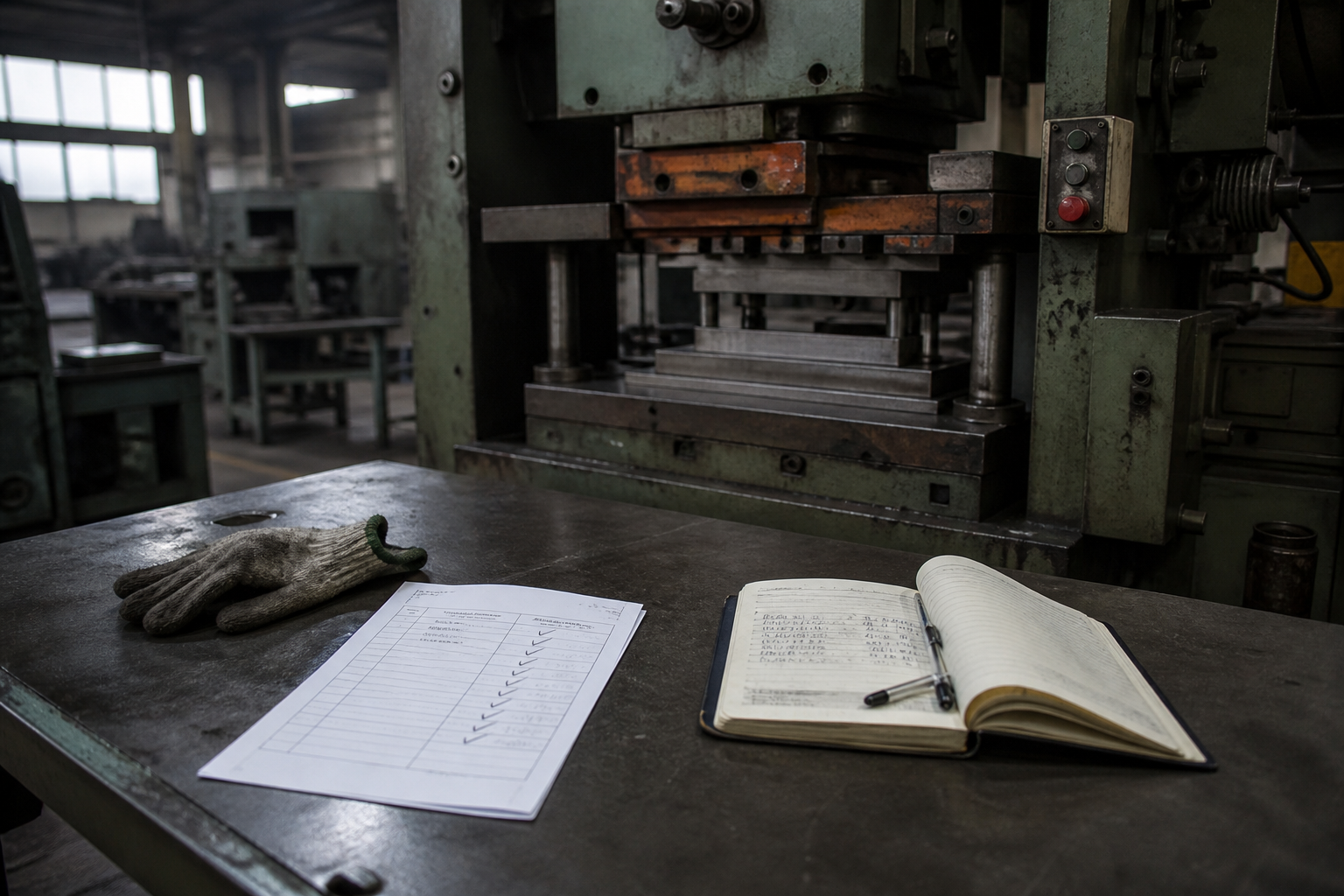
During the night shift on Monday, the stamping machine experienced three short stops. The shift leader checked the inspection sheet, which showed lubrication, air pressure, and mold fixation as completed, and allowed the production line to continue.
On the early shift the next day, the same machine stopped again after a change of operators. The maintenance technician said the machine had only been reset the previous night, and the operator claimed they had completed the inspection as per the sheet. However, the shop floor supervisor still could not determine when the risk had started to escalate.
The night shift, day shift, and maintenance team all left their inspection marks, but no record connected the abnormal noise, temporary fixes, trial-run results, and the risks the next shift needed to monitor.
Many factories believe the issue lies in poor execution, but more often, the problem is that the handover facts are too thin. The sheet is filled out, but the risk is not fully transferred.
For factory owners, this is not just a sheet issue—it reflects that permissions, responsibilities, authorizations, and boundaries have not been embedded in the handover process. The benefit of keeping the machine running is immediately visible to the current shift, while the risk is left for the next shift, affecting quality and customers.
The First Breakpoint: The Sheet Only Records Completion
Most inspection sheets are good at answering whether something was checked, but not what was observed after the check. A slightly higher temperature, a slightly louder sound, or a slightly heavier feel is often reduced to a single check mark.
This approach may seem efficient, but it breaks continuous anomalies into several sporadic incidents. Each shift treats the issue as if encountering it for the first time, and no one can be certain what signals the previous shift may have observed.
For managers, the most dangerous thing is not missing inspections, but failing to cross shift boundaries with reminders.
The Second Breakpoint: Temporary Fixes Are Marked as Resolved
The most common action during the night shift is to tighten, clean, and reset the equipment to restore it to a runnable state. Once the production line restarts, many records will assume that the issue has been resolved.
What should be transferred is not just a statement of 'processed,' but three facts: which part remains unstable, under what conditions it may recur, and what the first piece of the next shift should verify.
If these facts are not clearly documented, the early shift will not receive a risk warning, but rather a machine that appears normal. Only when the cycle time drops again will the shop floor start from scratch to investigate.
Anyone who proactively documents the risk clearly often faces responsibility and escalation; those who only write 'processed' are safer in the short term, so self-preservation tends to override genuine handover.
The Third Breakpoint: Test Results Are Not Linked to Product Risks
After equipment restoration, many teams only check if the machine can run, without inspecting the first and last pieces and the small batch of in-process products before and after restoration for any residual issues. This results in handover only reflecting machine status, not product status.
Turn Handover into Three Shop-Floor Statements
First, describe the phenomenon without making judgments, such as which side has abnormal noise or which section is slower. Second, write temporary measures and test scope, indicating whether the machine is just restored or has been validated. Third, note the first priority action for the next shift, so the incoming team knows where to start checking.
These three steps are more useful than adding ten checkmarks. They shift responsibility from who filled out the form to who clearly communicated the risks.
Some factories with few machines and shifts can use a whiteboard for shift handover, but if there is frequent cross-shift, cross-maintenance, or cross-quality coordination, a single approach should not be considered a default solution.
Small, loosely managed factories should start with a single problematic machine. Medium-sized growing factories should unify the language for handover between teams, maintenance, and quality. Large factories should prevent situations where no one takes responsibility.
Owners can directly forward these three steps of the handover mechanism to plant managers, workshop supervisors, and shift leaders, requiring them to follow the same inspection checklist and fill it out after every machine stoppage and restoration. This transforms handover from just a form into a management action that can be escalated, coordinated, and closed.
Inspection sheets are not meant to prove who performed the task, but to ensure the next shift takes over with the same set of facts. Equipment downtime that occurs continuously is often not due to lack of inspection, but rather the risk was not properly transferred.
I am Huang Chaoxing, inventor of the TreeMES stack-light MES system. Follow me for in-depth insights into the management logic behind frontline stories in manufacturing.
