
When Frontline Exceptions Go Unreported, Employee Cooperation May Not Be the Problem
At 2 a.m., the factory owner asked in the group chat: Why is this batch late again? Production, maintenance, warehouse, and quality control each had their own explanation. Many exceptions aren't unnoticed; rather, those who see them don't know whether to report or if someone will take action.
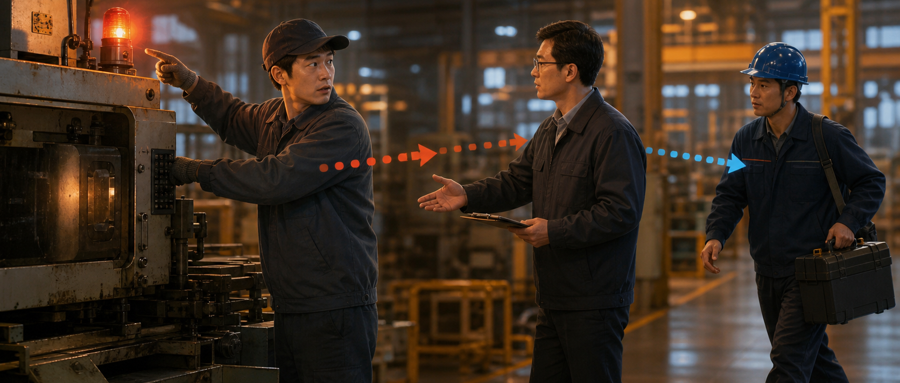
At 2 a.m., the factory owner asked in the group chat: Why is this batch still delayed?
The group remained quiet for a few minutes. Production said the equipment had stopped the previous night, maintenance mentioned receiving the message at 10:30 p.m., warehouse stated materials were ready by afternoon, and quality control noted that no one submitted the part for first-off inspection. Each statement seemed reasonable, but together, the situation became even more confusing.
The next day during a review, many factory owners attribute the problem to a single sentence: frontline employees are not proactive.
However, the reality on the shop floor is often more complex. Many exceptions are not due to lack of observation, but rather people seeing the issue are unsure whether they should report it, whether it will be addressed, or whether they will be held accountable for reporting it incorrectly.
1. Why do employees choose to remain silent?
Frontline employees are not naturally resistant to reporting exceptions. What truly causes silence is usually one of three experiences.
First, no one responds. Employees have reported several times about equipment noise, incorrect materials, and poor tooling performance, but the issues circulate in the group without anyone closing the report. Over time, they come to believe that reporting or not reporting makes no difference.
Second, reporting is met with skepticism. When an exception is reported, management's first question is not 'Who will handle it,' but rather 'Why are you reporting it now?' or 'Did you operate incorrectly?' Employees will naturally hesitate before reporting issues in the future.
Third, reporting becomes a personal responsibility. Initially, an employee only identifies an issue, but eventually, it becomes their task to follow up with maintenance, follow up with the warehouse, and wait for quality inspection. Employees develop a simple understanding: reporting an exception brings more trouble.
Therefore, the lack of frontline exception reporting is not merely an attitude issue, but a systemic issue.
2. The most concerning aspect of abnormal feedback is the lack of follow-through
An exception, from discovery to closure, requires at least four actions: discovery, acknowledgment, handling, and closure.
Many factories only require employees to identify exceptions, but do not define the subsequent three steps. Once an employee raises an issue, who will acknowledge it? How quickly will they respond? If the issue cannot be resolved, how will it be escalated? And who will confirm the closure?
Without clear guidelines, exceptions will remain stuck in the air.
What the frontline truly needs is not a larger group or more forms, but a clear handoff. Employees just need to pass the first baton; the next must be picked up by someone. If no one takes it, the system or rules should automatically escalate, not require employees to seek help manually.
It is at this point that the value of MES becomes evident: it does not replace management in monitoring employees, but transforms exceptions from a verbal statement into a traceable record.
3. Before rushing into assessments, address the sense of security first
Many factory owners hear that exceptions are not reported and immediately think of implementing penalties: penalize for not reporting, penalize for delayed reporting, and penalize for missed reports.
Penalties are not necessarily off-limits, but the order must be correct. If employees discover an exception but there is no clear person to take ownership, no defined time limit, and no closure feedback, applying penalties first will only encourage the frontline to hide problems.
A better approach is to first provide employees with three certainties.
First, following the rules to report is not taking the blame. Second, once reported, someone must take it up. Third, the handling result must return to the shop floor, so the person who found the issue knows the matter did not fall into a black hole.
When employees believe that reporting exceptions is not causing them trouble, exception reporting can speed up.
4. A small change: automatic escalation if no response within fifteen minutes
If you want to change things starting tomorrow, there's no need to implement a complex system right away.
Start by selecting three most common types of exceptions: machine stoppage, material waiting, and first-off inspection delay. For each type of exception, assign a first point of contact and a response time. For example, the maintenance technician should acknowledge machine stoppage within ten minutes, the warehouse should confirm material waiting within fifteen minutes, and the quality inspector should provide a conclusion for first-off inspection within fifteen minutes.
If no one responds within the time limit, the issue should automatically escalate to the team leader or production supervisor. Escalation is not for punishment, but to ensure the problem does not remain unresolved.
After running for two weeks, the factory owner can review the data: which exceptions occur most frequently, which types of responses are slowest, and which steps consistently remain unresolved. At this point, discussions on process optimization, performance, and system features can be based on factual data.
5. The one question the factory owner really wants to ask
Do not first ask employees why they do not report.
First ask: Who will definitely take ownership once an issue is reported?
Clarifying this question can reveal the true management gaps behind many so-called execution issues.
Whether frontline workers are willing to report anomalies depends not only on their attitude but also on whether the factory connects the person who identifies the issue with the person who resolves it.
If they are connected, anomalies become opportunities for improvement; if not, they become silent costs.
I am Huang Chaoxing, inventor of the TreeMES stack-light MES system. Follow me for ongoing analysis of shop-floor management and manufacturing digitalization.
