
A Pre-Shift Meeting Is Not a Pep Talk: Three Things Production Managers Need to Clarify
Pre-shift meetings happen every day, yet the same problems recur. Managers often assume employees did not listen, team leaders lack authority, or the meeting was too short.
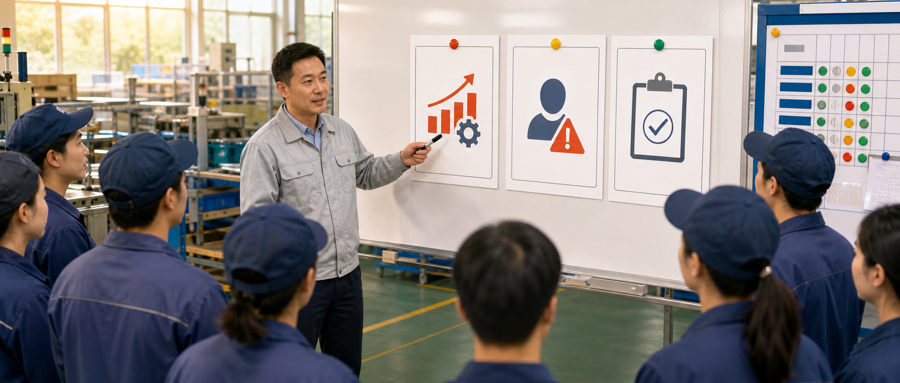
The pre-shift meeting is not about shouting slogans. It is enough for the production manager to clarify these three things.
Daily pre-shift meetings are held, yet problems keep recurring. Many managers' first reaction is: Are the employees not listening, does the team leader lack authority, or is the meeting too short?
on the shop floor, the real failure of pre-shift meetings is often not due to lack of seriousness, but because the meeting content does not address 'how to do today's work'. If the meeting only discusses safety, discipline, and production slogans, employees will still not know which order to prioritize, which equipment is risky, or which anomalies require immediate reporting. The pre-shift meeting then becomes a ritual.
This article does not discuss big theories; it provides three actionable items for shop floor managers to implement immediately during pre-shift meetings.
1. The first thing: Which critical point are you most concerned about today?
Pre-shift meetings should not start by discussing ten things; instead, focus on the one most critical risk point for today.
This risk point could be equipment, materials, first-off inspection, changeover, urgent orders, or rework. The key is not to list all risks, but to make everyone aware: if something goes wrong today, the most likely point of failure will be here.
For example, if there is an urgent order that needs to pass through a bottleneck process, the pre-shift meeting should not just say 'everyone work hard'. Instead, it should clarify: this order must reach a certain process by a specific time. If the previous process is delayed by twenty minutes, who will notify, to whom, and whether the sequence needs to be adjusted first.
The first sentence of the pre-shift meeting should start with 'What do we most fear today' rather than 'Everyone must take it seriously.'
2. The second thing: Who is responsible for the first alert?
Many abnormalities are not due to lack of observation, but due to lack of courage to be the first to report them.
If the equipment makes abnormal sounds, workers may want to wait; if the material quantity is insufficient, the warehouse may think the shop floor will notice it themselves; if the first-off inspection is blocked, quality control may assume production already knows. Each position thinks 'let's check again,' and eventually, the factory owner finds out only at night.
Therefore, the pre-shift meeting must designate someone to be the first to raise an alert.
It is not to make them take the blame, but to give them the authority to speak up. For example: equipment abnormalities should be reported first by the operator; if the maintenance technician does not respond within ten minutes, the team leader should escalate; material discrepancies should be reported first by the material receiver, with the warehouse and planning department confirming in sync; if the first-off inspection is not closed within fifteen minutes, quality control must provide the reason for the delay.
In short, the pre-shift meeting is not about assigning responsibility, but about clearly defining who should be the first to raise an alert in case of abnormalities.
3. The third thing: What evidence should be left before the shift ends?
If the pre-shift meeting only focuses on starting without addressing the conclusion, the same issues will resurface the next day.
The shop floor supervisor must clearly state during the meeting what evidence must be left by the end of the shift. This could include records of bottleneck equipment downtime, completion milestones for urgent orders, reasons for material shortages, or status of rework closures.
The evidence does not need to be complex, but it must be traceable for review. Avoid simply writing 'processed'; instead, clearly document when the issue was discovered, who handled it, how long it took, and whether it affected the order.
MES, ERP, kanban, and forms are just tools. What truly matters is capturing actions on the shop floor so that adjustments can be made based on facts the next day, rather than continuing to rely on intuition during meetings.
4. A pre-shift meeting template that can be directly copied
The production manager can shorten the pre-shift meeting to five minutes:
- What is the most important order today; - Where is it most likely to get stuck; - Who is responsible for the first alert; - How long must it take before escalation is required; - What evidence must be left by the end of the shift.
If these five questions are not clearly addressed, a 20-minute meeting may still be ineffective.
If these five statements are clearly communicated, even a five-minute meeting will ensure that shop-floor personnel know what to focus on, who can raise issues, and how to escalate problems when they occur.
5. Judgment criteria for factory owners
The value of a pre-shift meeting should not be judged by how loud the voices are or how neatly the team is lined up.
Only three outcomes matter: employees understand the key priorities for the day; someone reports issues immediately when they occur; and there is evidence available for review at the end of the shift.
Achieving these three points ensures that the pre-shift meeting is not just empty talk, but the starting button for shop-floor management.