
Why More Detailed Daily Reports Can Slow Shop-Floor Decisions
By 8:30 a.m., the daily production report already covers output, attainment, downtime, rework, shortages, and attendance. Yet when the factory owner asks which issue is most likely to affect today’s delivery, the team still has to reconstruct the answer across planning, materials, quality, and production.
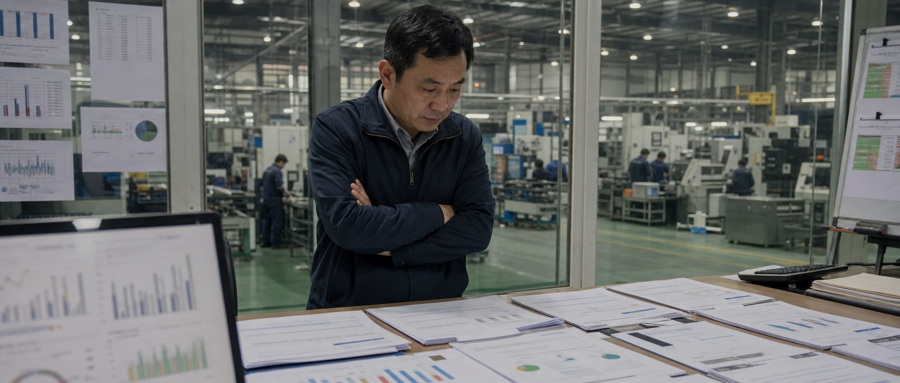
By 8:30 a.m., the daily production report has already been posted in the group chat. It includes the previous day’s output, attainment, downtime, rework, material shortages, and attendance. The factory owner asks, ‘Which issue is most likely to affect delivery today?’ The shop floor still cannot answer directly: production asks planning, planning checks material readiness, and quality identifies two batches still awaiting disposition. The report is complete, but the decision bottleneck still has to be traced from the beginning.
This isn't because the report isn't detailed enough; many daily reports are good at explaining yesterday but not designed to support today. More data means longer reading time; more definitions mean responsibility can easily hide in attachments. For factory owners, the report should form a chain of facts, impact, responsibility, and action on the shop floor, exposing today's necessary decisions in advance.
1. Completeness Is the Easiest Way to Create a False Sense of Management Security
Daily reports have numbers, charts, and reasons, making management feel that the shop floor is visible. However, 'seeing yesterday' is not the same as 'deciding today.' Yesterday's 80 minutes of downtime is a fact, but whether it will affect urgent orders today is the decision-making issue.
Many departments naturally write reports as self-explanations. Production explains the lack of achievement due to material shortages, warehouse explains material shortages due to procurement delays, and quality explains pending judgment due to late testing. Each statement may be correct, but no one takes responsibility for synthesizing these facts into an action sequence.
This is also related to real-world incentives. The more complete the report, the easier it is for departments to prove they have reported; giving a clear judgment, however, may carry the risk of being wrong and taking responsibility. Without appropriate authority, people tend to avoid taking ownership, leading to more mistakes with more actions; only submitting data and avoiding judgment can lead to fewer mistakes. Thus, the safest way to protect oneself is to include all information and leave the selection to the factory owner.
2. The Daily Report Is Slow, Not Because the Data Is Late, But Because of the Lack of Context
A '40-minute equipment downtime' lacks order context, not knowing which order it affects; 'three material shortages' lack time context, not knowing when they will arrive; '20 reworks' lack quality context, not knowing whether they will delay the next process.
If daily reports only aggregate departmental data, they create several information silos. The factory owner must reassemble data on equipment reliability, material completeness, quality status, and personnel workload to determine whether an urgent order can be fulfilled.
A truly useful daily report should be organized around objects rather than departments. It can be structured around key orders, bottleneck equipment, and major anomalies, placing related facts in the same row. This way, planning, production, quality, and equipment teams see the same event, not four separate tables that explain each other.
3. Change the Daily Report from the Results Table to the Decision Table
First, write the facts: what happened. Second, write the impact: which order, which process, and how much production will be delayed. Third, write today's actions: who will complete what by what time. Finally, write the required decisions: whether to insert an order, stop the line, approve, reassign personnel, or adjust commitments.
It is especially important to distinguish between 'known risks' and 'pending decisions.' Known risks can be handled by the responsible role; pending decisions must be addressed by someone with authority during morning meetings or tiered short meetings. Red is not for visibility, but to trigger action.
Daily reports also need an exit mechanism. Fields that remain unacted upon for a month should be deleted or reduced in frequency; indicators that require offline follow-up to understand should have additional context added; and numbers that appear repeatedly across multiple reports should have a clear single source.
4. Look at Different Issues at Three Levels
Team daily reports focus on execution during the shift: current gaps, unresolved anomalies, and risks for the next shift. Workshop daily reports look at cross-shift coordination: order, material, equipment, and quality conflicts in the next four hours. Executive daily reports focus on operational trade-offs: which commitments may be missed, what resources are needed, and who is responsible for closing them.
The same set of facts can be used across three levels, but the same table cannot be simply duplicated. Operators who see profit metrics they cannot influence will feel it is unrelated to them; foremen without cross-departmental authority yet required to handle all red items will lead to mismatched responsibilities and permissions; owners buried in details of each machine will lose the ability to make trade-offs.
Small, loosely managed factories can first condense daily reports into 'Three Key Things Today'; mid-sized growing factories should focus on placing cross-departmental risks under the same subject; large or mature factories need to reduce redundant summaries and layered embellishments, retaining the path from conclusion back to original facts.
5. The Factory Owner Only Asks Four Questions Every Day
What are the three most likely things today that could affect delivery, quality, or cost? Who is responsible for each item now? When will the next feedback be available? If it is overdue, what decisions do I need to make?
These four questions will force daily reports to shift from description to action. If they cannot be answered, it indicates that the report is missing not more data, but responsibility, time, and authority.
Daily reports are not necessarily better when shorter. Some factories still need to retain complete records of safety, quality, and compliance, and complex factories require detailed breakdowns. However, in practice, management reports should not take on the full function of archives. Archives pursue completeness, while decisions require relevance, timeliness, and actionable insights. Both can reference the same facts but do not need to be presented as the same table.
Owners can forward this checklist to plant managers, shop floor supervisors, and team leaders: a good daily report should not prompt further questions like 'What exactly happened?' after reading it, but should immediately inform the shop floor of 'What to do first today, who will do it, when to escalate, and when to close it.' Daily reports are not materials for defending past actions, but entry points for today's actions.
I am Huang Chaoxing, inventor of the TreeMES stack-light MES system, and I focus on analyzing shop-floor management and digitalization trends in manufacturing.