
Equipment Restored—Why Does the Same Downtime Keep Returning?
The same equipment fault can return even after production resumes. Preventing recurrence requires separating temporary restoration from verified problem closure, preserving the fault context, and assigning clear cross-functional ownership.
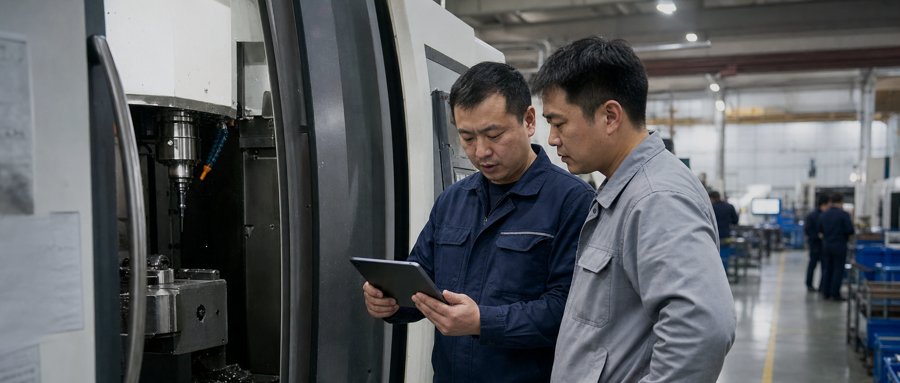
On Monday’s morning shift, the No. 3 machining center reported a spindle alarm. A maintenance technician replaced the sensor, and the machine resumed operation two hours later. The same alarm returned on Wednesday’s night shift. The technician on duty reseated the connector, and the machine restarted. On Friday, while the factory was handling a rush order, the alarm appeared a third time and left a batch of parts awaiting dimensional disposition. Production said maintenance had not resolved the fault thoroughly; maintenance said production had been restored each time. The equipment supervisor opened the work orders and found three different records: ‘spindle alarm,’ ‘poor contact,’ and ‘sensor abnormality.’
The machine is always repaired, yet downtime keeps recurring. The issue often lies not in the maintenance technician's lack of skill, but in the factory treating 'restoring production' as 'problem closure.' The former only answers whether the machine can operate now, while the latter also requires answering why it stopped, whether the impact has been cleared, and whether similar risks will recur.
For factory owners, repeated downtime losses are not only about maintenance time but also affect delivery schedules, quality, and shop-floor discipline. What needs to be addressed is a chain of shop-floor facts from alarm, temporary handling, impact confirmation to recurrence prevention verification, ensuring that responsibility is visible, the timing of issue escalation, and who ultimately closes the problem are all based on evidence.
1. The Easiest Thing to Reward on the Shop Floor Is Quick Recovery, Not Less Recurrence
After the equipment stops, the production supervisor first faces delivery schedule pressure, the team leader must explain production output, and the maintenance technician must quickly get the machine back online. For the on-duty personnel, the most practical choice is to first reset, replace parts, and get the line running again. As long as the machine is restored, everyone can temporarily breathe a sigh of relief.
However, root cause analysis often requires more time: preserving the alarm context, checking recent adjustments, comparing similar work orders, and sometimes even verifying by stopping the machine. If the maintenance technician proactively requests to continue the downtime, they may be seen as slow and liable; if they prioritize restoring production, the short-term result is immediately visible. This is a typical case of inconsistent authority, responsibility, reward, and risk, which can also lead to a self-protecting logic of 'more work, more mistakes; less work, less mistakes.'
Small, loosely managed factories often rely on experienced technicians' experience, with the repair being verbally confirmed; mid-sized growing factories have work orders but equate closure with filling out the form; large or mature factories have more complete records, but due to excessive professional specialization, electrical, mechanical, and process teams each close their own tasks, with no one taking responsibility for recurrence. The manifestations differ, but the break point is the same: someone is responsible for restoration, but no one is responsible for recurrence.
2. The Same Fault Is Often Hidden in Three Ways of Writing
A machine's similar issue may be described differently by operators, maintenance technicians, and equipment engineers. For example, an operator might write 'spindle alarm,' a technician might note 'sensor looseness,' and an engineer might report 'connector contact failure.' These three statements describe the same fault chain but appear as three different reasons in statistics.
If work orders only allow one free-text field, factories often see many 'other' entries, frequent minor issues, and few repeated downtime events. The reality may be the opposite: the same weakness recurs, but different terms are used by each person.
Therefore, repeated downtime can be uniformly recorded in three steps. First, identify the fault object, specifying the equipment, location, and function. Second, describe the shop-floor phenomenon, including alarms, sounds, temperature, dimensions, or cycle changes. Third, record the temporary action, such as reset, tightening, replacement, or parameter adjustment. Root cause analysis can be conducted later, but facts cannot be fabricated.
3. Recovery, Verification, and Shutdown Must Be in Three States
"Restored" only means the equipment is back in operation. "Pending verification" indicates the temporary action is complete, but further observation over a set period or production volume is needed. "Closed" requires confirmation of the impact scope, root cause determination, completion of corrective actions, and verification of prevention measures.
For example, after replacing a sensor, the issue should not be immediately closed. It can be specified that verification occurs after two consecutive shifts, completion of a changeover, or reaching a set production volume. If the alarm reappears during this period, the work order should return to the original issue, not create a new unrelated record.
Quality risks should also be addressed together. Equipment recovery does not automatically ensure product safety before and after downtime. Which batches need isolation, who decides release, and whether parameter adjustments affect critical dimensions should all be included in the same closure chain.
4. Factory Owners Only Pursue Three Types of Recurrence Facts Every Week
First, the same equipment, same location, and similar phenomena have occurred several times within seven or thirty days. Second, which issues remain in the 'restored' status for a long time without entering verification and closure. Third, which temporary measures are most frequently repeated, such as repeatedly resetting, re-plugging, adding oil, tightening, or adjusting parameters.
The plant manager can forward these three categories of facts to equipment, production, and quality for joint review. Equipment is responsible for technical judgment, production for preserving shop-floor context, and quality for confirming product impact. Abnormalities are first acknowledged by team leaders, escalated and transferred if beyond their authority, with higher-level management responsible for line stoppage, modification, or resource prioritization. Responsibility should not be entirely placed on maintenance, nor should 'production first' automatically become the sole priority.
This checklist and closure mechanism is more suitable for discrete manufacturing plants with dense equipment, frequent changeovers, and frequent temporary adjustments. Not all plants require complex procedures; some have stable equipment, mature maintenance cycles, and few repeated failures, so keeping simple records is sufficient. However, in reality, if similar downtime keeps recurring, the language of work orders, processing status, and recurrence responsibility should be standardized first.
True reliable equipment management is not about fixing issues quickly every time, but ensuring the same problem does not need repeated fixes. Resuming production is the first step, while verifying the cause and preventing recurrence is the true closure.
I am Huang Chaoxing, inventor of the TreeMES stack-light MES system. Follow me to explore the management logic behind frontline stories in manufacturing.
