
How Should Factories Classify Downtime Causes? Start with a Four-Level Taxonomy
One machine stops for 40 minutes. The operator records an equipment fault, maintenance points to unprepared tooling, and planning calls it a changeover delay. Without a shared downtime taxonomy, management sees the duration but cannot tell whether to improve equipment, material readiness, or scheduling.
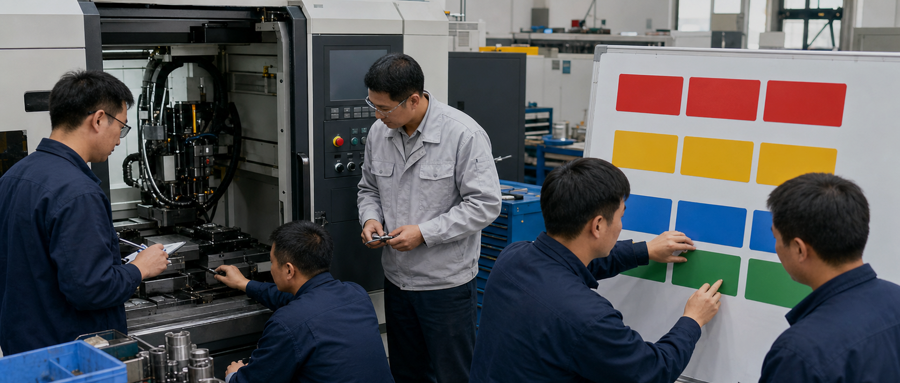
The same machine stops for 40 minutes. The operator records an ‘equipment failure,’ maintenance says the tooling was not ready, and planning categorizes it as a changeover delay. At month-end, three reports show three different causes. The factory owner sees only the downtime duration and cannot tell whether the next improvement should address equipment, material readiness, or scheduling.
Many factories aren't lacking downtime data; the issue is that the classification has always been mixed up from the start: phenomena, triggering causes, responsible stages, and root causes are all packed into a single dropdown menu. The result is neat statistics, but no one on the shop floor can act based on them, and factory owners can't reconstruct a reliable chain of events from the downtime records.
The following four-level list doesn't aim to perfectly analyze the root cause in one go, but rather ensures that every downtime event can be described using the same language.
First Level: Remember 'What You Saw'
The first level only records the shop-floor phenomenon without rushing to assign responsibility. For example, equipment alarm, no material waiting, quality pending, incomplete changeover, personnel not in place, or production paused. The phenomenon must be selected by the on-duty personnel at the time of occurrence, as this is when the information is closest to the actual situation.
The most common mistake here is treating 'equipment failure' as a universal category. Equipment stopping is just a result; the underlying cause could be a safety trigger, incomplete tooling, missing parts from the previous stage, unapproved first-off inspection, or even a last-minute production cancellation. The goal of the first level is to answer 'why production stopped at this moment,' not to answer 'who is to blame in the end.'
The checklist includes three items: whether the start time is automatically or timely recorded; whether the downtime object is clearly defined to the equipment and process; and whether the recovery time is confirmed on the shop floor. If any of these three are missing, the subsequent analysis may be based on incorrect duration.
Second Level: Subdivide 'Which Condition Is Not Met'
For continuous production, equipment at least requires four categories of conditions: equipment, materials, methods, and personnel. The second level classifies based on these conditions.
Equipment conditions include faults, protection, inspections, and maintenance; material conditions include material shortages, incorrect materials, and batch confirmation pending; method conditions include process parameters, program versions, first-off inspection approval, and changeover preparation; personnel conditions include skills, attendance, authorization, and support.
The value of this level of classification is to reframe downtime from 'a problem at a certain position' to 'a missing production condition.' For example, if a tool is not in place, it may not necessarily be a problem with the maintenance technician; it could be that the changeover checklist was not triggered in advance. Similarly, waiting for first-off inspection may not necessarily indicate slow quality control; it could be that the inspection time was not recorded. Clarifying the conditions first provides a common basis for cross-departmental discussion.
Level 3: Identify 'Who Can Drive Recovery'
The third level is not about assigning blame, but determining the owner of the current action. Who resets equipment protection, who confirms the material arrival time for shortages, who provides the release conclusion for quality hold, and who decides to resume after a planned pause.
Each cause must have a primary owner and an escalation role. The primary owner acknowledges the issue and updates its status; the escalation role takes over decisions when the response is overdue or exceeds the primary owner’s authority. Coordination cannot be placed entirely on the team leader. If the team leader cannot mobilize quality, warehouse, or maintenance resources but is held accountable for all downtime losses, the result will be repeated chasing with no one truly taking ownership.
Check four fields: acknowledgment time, first response, estimated recovery, and actual closure. Without an acknowledgment time, it is impossible to distinguish between ‘no one knew’ and ‘someone knew but did not act.’ Without an estimated recovery time, planners cannot adjust subsequent orders.
Level 4: Reconfirm 'Root Causes and Recurrence Prevention Actions' When Closing
Root causes should not be guessed by operators immediately after a downtime event. Confirm the root cause during the closure phase: was it tool wear, missing standards, inadequate preparation, version error, or uncommunicated plan changes? The root cause can be delayed, but it should not remain as 'other' indefinitely.
Preventive actions must be specific. Avoid vague statements like 'enhance training' or 'improve responsibility.' Instead, write verifiable changes: move tool preparation two hours before changeover; automatically escalate if first-off inspection exceeds agreed time; trigger specialized inspections if similar protection is triggered twice within a week; allow machine startup only after program versions are system-verified.
Use Four Steps to Clean Up Old Data into a Usable List
First, export the last month's downtime records, and list high-frequency categories like 'equipment failure' and 'other' separately. Second, randomly select ten records each from operators, maintenance, quality, and planning for joint review, focusing only on which conditions were missing. Third, consolidate repeated answers into no more than twenty secondary causes, and test them on a single bottleneck line first. Fourth, weekly check the proportion of 'other' and recurring downtime, and add new causes as needed, but avoid unlimited growth in the dropdown list.
This checklist should also be run before system implementation. While the system can automatically record time, it cannot define responsibility boundaries for the factory. Without consensus on classification, automatic data collection will only accelerate the generation of non-actionable data.
This approach suits discrete manufacturers with frequent downtime, inconsistent cause definitions, and recurring cross-departmental disputes. Small factories with informal management should first standardize basic causes. Mid-sized growing factories should strengthen cross-departmental ownership and escalation. Large or mature factories should guard against excessive classification and rigid responsibilities. Process industries or highly automated lines may require more detailed safety and process categories and should not copy this method unchanged. Regardless of system complexity, downtime records must ultimately answer four questions: what was observed, which condition was missing, who can drive recovery, and how recurrence will be prevented.
Classification rules must consider authority, responsibility, incentives, and risk together. If people who proactively take ownership consistently do more work and carry more blame, while others can leave issues under ‘Other,’ even the best cause library will be undermined by actual workplace behavior.
factory owners don't need to check all downtime details daily; they just need to focus on three changes: whether repeated downtime has decreased, whether 'other' has reduced, and whether unresolved downtime beyond the time limit has been escalated. Only classification that drives action is useful downtime data.
