
Why Higher Automation Can Make Small-Batch Delivery Harder
A high-speed automated line performs well during demonstrations and handles bulk orders smoothly. However, with multiple product models, the shop floor experiences frequent program changes, tooling swaps, and sensor adjustments. When urgent orders arrive, engineers are still validating the previous product. Despite high equipment utilization, the owner notices increasing wait times for small-batch orders.
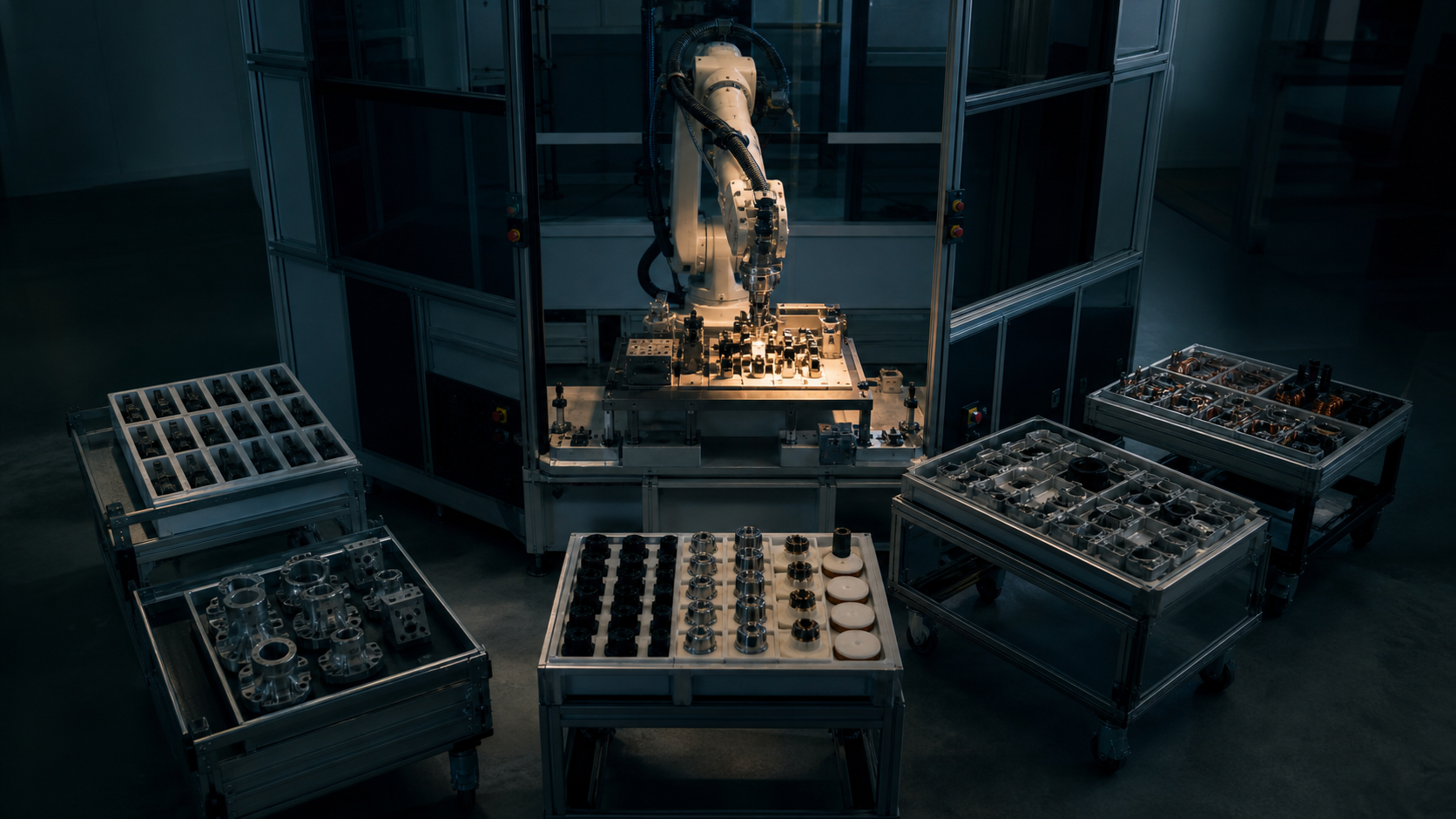
An automated line can run quickly during demonstrations and handle bulk orders smoothly. However, as product variety increases, the shop floor faces frequent program changes, tooling swaps, and sensor adjustments. Rush orders arrive while engineers are still validating the previous product. The factory owner sees high equipment utilization but finds that small-batch orders are waiting longer.
Automation itself is not the issue. The problem lies in many factories purchasing the ability to 'repeat the same task,' while operations require the ability to 'quickly switch between many different tasks.' For high-mix, low-volume factories, single-piece running speed is just one result. Programming, changeover, validation, recovery from anomalies, and personnel capability collectively determine delivery. Factory owners need a site fact chain that explains preparation, operation, switching, and recovery.
Automation Fixes the Action and the Premise
Manual operations can adapt to part positions, batch differences, and temporary sequences using experience. Fixed automation, however, requires more stable inputs: consistent material posture, reliable fixture positioning, correct program versions, and quality standards that can be judged by machines. Any change in these prerequisites may require engineers to reconfigure and validate.
As a result, a counterintuitive phenomenon appears on the shop floor: equipment runs faster, but the waiting time before it starts is longer. Small-batch orders produce only dozens of pieces. When programming and validation time is spread across each product, it may not be more efficient than manual operations. If management only looks at cycle time and equipment utilization, they will overlook this preparation cost.
NIST guidance for small and medium-sized manufacturers notes that high-mix, low-volume environments need more flexible automation. Selecting and integrating robots, sensors, and tooling in dynamic, unstructured shop-floor environments also requires reproducible evaluation methods. Advanced technology should be judged not only by feature count, but by how quickly it can be retasked and how reliably it performs as products change.
Partial Automation Pushes Waiting Elsewhere
After automated workstations speed up, if preceding material handling, quality confirmation, program release, and downstream receiving are not synchronized, waiting will not disappear but will be transferred. Accumulating more in-process inventory before the automated line or having products queue in the inspection area after the automated line completes can make the total order cycle longer.
Departmental incentives can exacerbate this issue. The equipment team is responsible for equipment utilization and the safest approach is to run long orders continuously to minimize changeovers; the planning team is responsible for delivery and wants to insert urgent orders at any time; the engineering team is concerned about quality risks from unverified changeovers. Each role is protecting its own objectives, yet no one has ownership of the entire order cycle from order entry to delivery completion. This is not a matter of willingness to cooperate, but rather a misalignment of authority, responsibility, rewards, and risk boundaries around the same order.
Requesting team leaders to 'flexibly coordinate' does not solve the problem. Team leaders typically lack the authority to change program validation, quality clearance, or engineering resource priorities. Taking initiative to accept orders may lead to more work and potential errors, or overstepping and taking responsibility; doing less and making fewer mistakes is safer. Only by clearly defining escalation, handover, and closure mechanisms can the waiting time between automated systems truly be addressed by someone.
When Evaluating Automation, Look at Five Costs of Change
The first step is to check the cost of changing products: how long does it take from the last conforming piece to the first conforming piece of the next product. The second step is to check programming costs: how many engineering hours are needed for a new model or engineering change. The third step is to check validation costs: what steps are required to reconfirm safety, quality, and cycle time. The fourth item is to check the cost of abnormal recovery: can regular staff recover from material jams, recognition failures, or equipment downtime? The fifth item is to check the cost of personnel dependency: whether only a few integration personnel can maintain the system.
These five factors should be included in investment evaluation along with cycle time and yield. A small-scale test can be conducted: select one high-frequency product, one low-frequency product, and one difficult product, and complete the switch, operation, and abnormal recovery continuously, recording the full order cycle rather than just the stable demonstration prepared by the equipment vendor.
If an automation solution shows significant benefits for high-frequency products but has excessively high preparation costs for long-tail products, it can be applied only to stable, repetitive, dangerous, or labor-intensive tasks, leaving the most variable tasks to humans. Collaborative robots are suitable for some high-mix, low-volume scenarios not just because of their speed, but also due to their reconfigurability and reduced reliance on specialized fixtures.
What the Factory Owner Wants to Ask Is Not 'How Many People Can I Replace?'
More valuable questions are: which types of orders can be delivered faster, who can reconfigure the system when product changes occur, how long does it take to recover from an abnormality, and what is the marginal cost of adding a new model. Only when these questions have answers is automation an operational capability, not just a machine that can only operate efficiently under ideal conditions.
Small-scale, loosely managed factories should first stabilize processes, materials, and quality boundaries before automating high-repetition tasks; mid-sized growing factories need to establish cross-departmental procedures, tooling, and engineering change management when accepting orders; large mature factories should avoid fixed production lines pursuing local utilization rates, which may sacrifice the flexibility required for product mix changes.
Higher automation does not necessarily make small-batch delivery more difficult; however, if a factory does not simultaneously invest in standards, data, changeover, validation, and personnel capabilities, faster machines will only hide change costs deeper. The automation truly suitable for high-mix low-volume production is first and foremost a system that can be quickly changed and consistently used by general personnel.
I am Huang Chaoxing, inventor of the TreeMES stack-light MES system. Follow me for continued analysis of shop-floor management and digital transformation trends in manufacturing.
