
Drawing Revised—Why Is the Shop Floor Still Building to the Old Version?
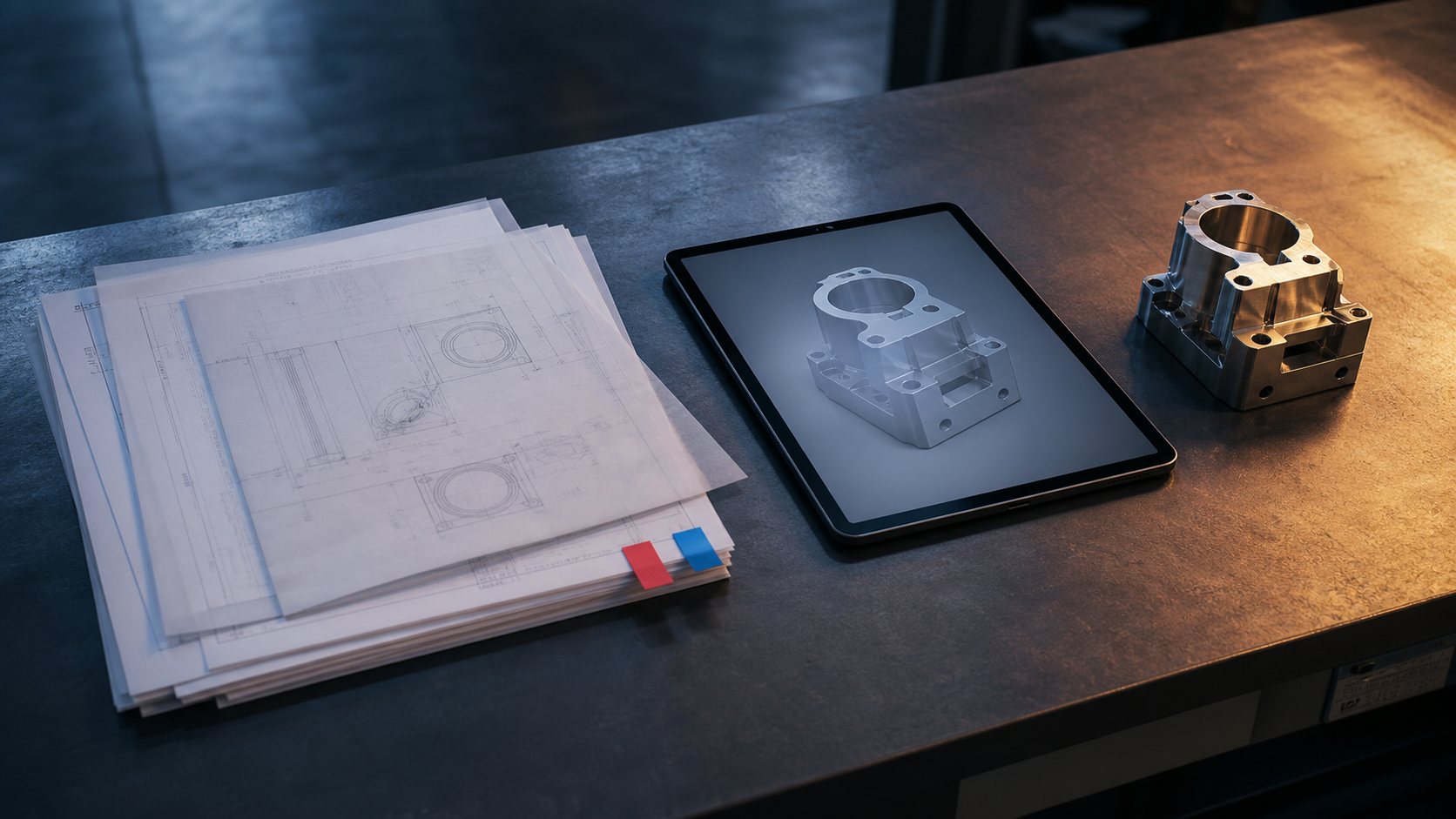
At 3 p.m., quality control found that hole positions in the final inspection did not match the revised drawing. Engineering stated that the change notice was issued in the morning, and planning indicated that the work order had been issued long ago. However, the shop floor supervisor pulled out an old version from the machine side: 'This is the version we received.' Further investigation revealed that the program server contained the new version, but the tooling cards still showed old dimensions, and the first-off inspection records only noted 'conforming' without indicating the referenced drawing version. Although a change notice had been issued, production had not actually switched to the new version.
Why Is the Shop Floor Still Producing According to the Old Version?
At 3 p.m., quality found that the hole positions did not match the revised drawing during final inspection. Engineering stated that the change notice had been issued in the morning, and planning claimed the work order had been issued long ago. However, the shop floor supervisor pulled out an old drawing from the machine side: 'This is the version we received.' Further investigation revealed that the program server contained the new version, but the tooling cards still had old dimensions, and the first-off inspection records only noted 'conforming' without indicating the drawing version used. A single change notice had been issued, but production on the shop floor had not actually switched to the new version.
This is not a problem that can be explained by saying 'employees didn't see the group message.' Design, process, planning, production, and quality use different information for the same product: drawings, programs, process cards, inspection specifications, and work orders. Changing only one document does not mean that the shop floor is ready to produce according to the new version. What factory owners truly need to manage is the actual chain of events from initiating the change, accepting ownership, replacing, executing, to closing it.
Issuing a Notification Does Not Mean Completing the Change
Engineering personnel usually have the authority to revise drawings and release them, but may not be able to check the program on each machine. Planning can pause or reschedule work orders, but may not know which in-process items have already been issued materials. Shop floor supervisors are responsible for output and quality, but may not have the authority to decide whether to continue with old batches. Each position completes its visible part, but the break point remains between positions.
The most common self-protective action on the shop floor is to produce according to the official documents in hand. Proactively stopping the line for verification may be questioned about affecting output; proactively replacing the program may be seen as overstepping authority. Without clear boundaries for stopping the line and rules for accepting the change, producing less and making fewer errors is safer. Thus, replying 'received' in the group becomes a formality, while the actual drawings, programs, tooling, and inspection requirements still move independently.
The emphasis of a digital thread in manufacturing is not to convert all documents into electronic files, but to ensure that product definitions can reliably exchange and be verified between design, manufacturing, and quality. As long as downstream processes still rely on manual interpretation, copying, and forwarding, version errors will not disappear simply because of system automation.
Step 1: Define What This Change Will Affect
An engineering change notice should at least answer five questions: from which order or sequence number does it take effect; which in-process items are affected; which documents among drawings, programs, processes, tooling, and inspection specifications must be synchronized; whether the old version is still allowed to be used; and who has the authority to confirm the completion of the switch.
The phrase 'take effect immediately' is often the most ambiguous. It fails to clarify what to do with existing inventory, partially processed items on machines, or whether batches that have already completed first-off inspection need re-inspection. Medium-sized growing factories are most prone to losing control here: departments are separated, multiple systems are in use, yet change scope still relies on individual judgment by familiar personnel.
If the impact scope is not confirmed, the change status should remain 'under evaluation' and cannot be directly marked as 'released'. 'Released' means the information is available, while 'closed' indicates that the shop floor conditions have been switched and evidence is in place. These two states should not be confused.
Step 2: Let the Shop Floor Use a Version Switching List to Receive Orders
First, verify the work order: are the order, batch, start sequence, and effective time clearly defined? Second, verify the product definition: are the drawing number, version, and key changes consistent? Third, verify the manufacturing conditions: do the program, parameters, tooling, tools, and materials need replacement? Fourth, verify the quality conditions: are the first-off inspection items, measuring tools, inspection specifications, and release rules synchronized? Fifth, handle the old version: has the paper drawing been collected, old programs locked, old tooling marked, and remaining in-process products disposed of?
Each item must have an acknowledgment from the responsible role and evidence of completion. Paper drawings can be signed for collection, program switching can retain version verification, and first-off records must clearly state the product definition version they are based on. The focus is not on adding signatures, but on enabling the next position to determine whether the information they receive is consistent.
Team leaders should only be responsible for shop-floor items they have authority to confirm. Decisions involving scrap, rework, concession acceptance, or order rescheduling should be handled by quality, engineering, or planning according to established rules. If frontline personnel are required to be accountable for results, stop, escalation, and handover boundaries must also be provided.
Step 3: Extract One Product Before Closing the Change and Reverse Trace It
When closing a change, do not only check if all stakeholders on the communication list have responded. Randomly select one product from the switched batch and reverse-check the work order version, used program, tooling status, first-off records, and inspection specifications. If any of these still point to the old version, the change has not been properly closed.
Small, loosely managed factories can start with controlled paper lists and a single file cabinet to avoid multiple group files existing simultaneously; mid-sized growing factories should establish cross-system version linkage and order acceptance timeouts; large mature factories must prevent excessive approval levels without verification of the actual version used on the shop floor.
Correcting the drawing is just completing the engineering work; ensuring the shop floor produces according to the new version stably is when the organization completes the change. The factory owner inspecting one change chain monthly is more effective in exposing real bottlenecks than asking whether the notification was sent.
I am Huang Chaoxing, inventor of the TreeMES stack-light MES system. Follow me for in-depth insights into the management logic behind frontline stories in manufacturing.
