
Awaiting Quality Disposition Delays Delivery? Align Isolation, Disposition and Release Records
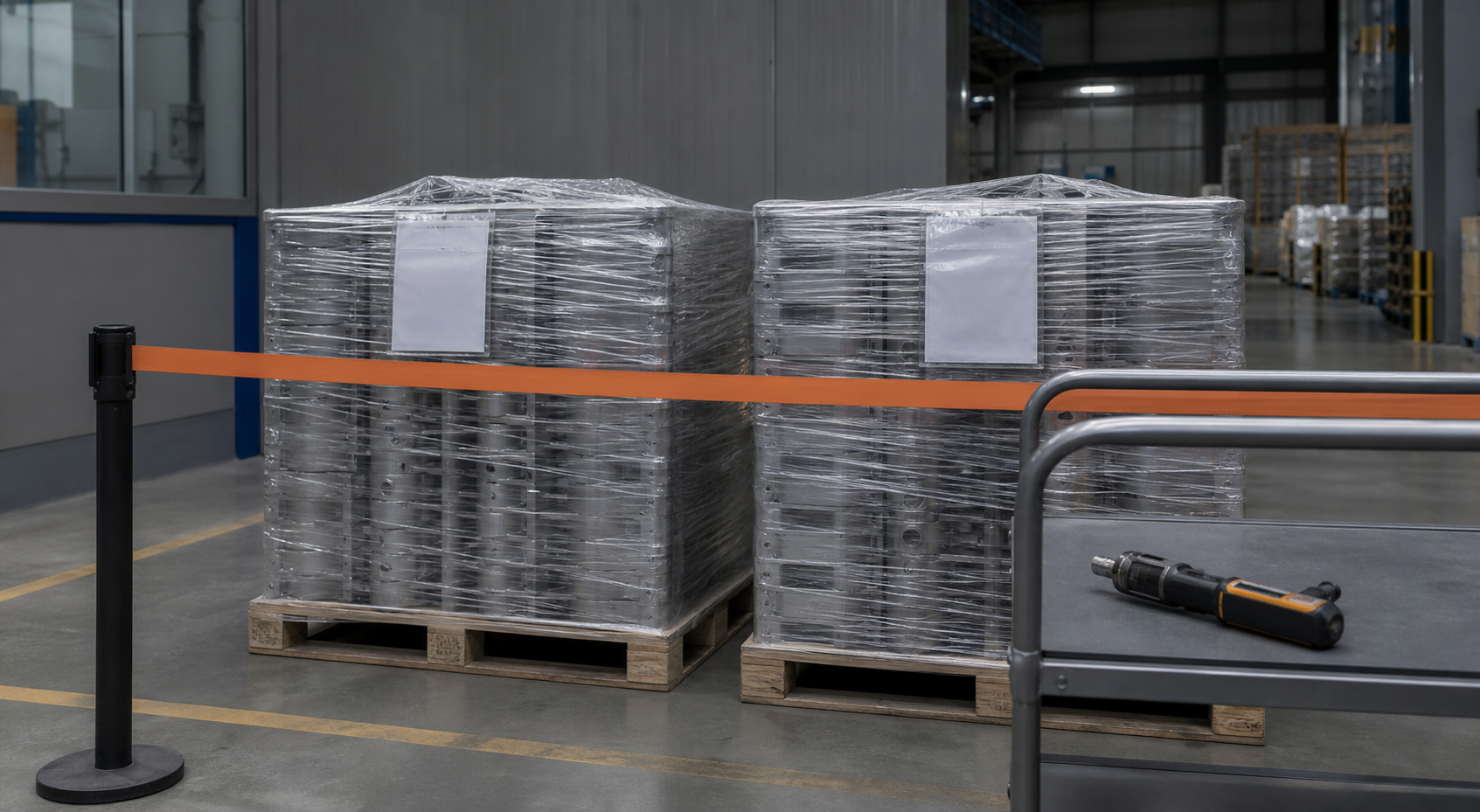
At 3 p.m., two pallets of finished goods are waiting under a quality-hold label. Planning, warehouse, quality, and production each see a different status, leaving management unable to decide whether the goods can move, who has release authority, or when a conclusion is due.
Quality Disposition Delays Delivery? Align Isolation, Disposition and Release Records
At 3 p.m., two pallets of finished goods sit at the warehouse entrance under a ‘Quality Hold’ label. Planning says they must ship that day, the warehouse sees available stock in the system, quality is waiting for retest results, and the production manager believes rework is complete. The factory owner cannot tell which status should drive the delivery decision, whether the goods may move, who has authority to decide, or when a conclusion is due.
The most dangerous aspect of quality under review is not just the long waiting time, but the inconsistency between the physical state, quality conclusion, and system inventory status. A physical isolation label is on site, but the system may still allow picking; the inspection has already given a conclusion, but the rework or release action has not been executed; the warehouse sees the inventory as available, while quality believes the product is still locked in the under review area. As long as one of the three records lags behind, the delivery pressure will push the risk back to the production line or the customer.
To truly close the quality under review status, don't rush to add more approvals. Align the isolation, disposition, and release records. At any moment, you should be able to answer: "Where is the item, what is the conclusion, and who will execute the next step."
The First Account: Locking the Risk Boundary First
Isolation is not just putting up a label; it also locks the object, quantity, location, and transfer permissions. At least, it should clearly state the product or material number, batch, current quantity, location, discovery time, abnormal phenomenon, and related work order.
Physical isolation and system freeze must occur simultaneously. Without a physical label, the system status may still allow normal picking; without a clear location, the item may be mixed back into normal inventory during movement, replenishment, or sorting.
Isolation scope must be based on evidence. Discovering one dimensional anomaly does not mean the entire month's products should be frozen, nor should only the immediate item be removed. First, check the same raw material, equipment, tooling, parameters, shift, and inspection window to determine the smallest yet sufficiently safe impact range. If the scope is temporarily uncertain, isolation can be initially expanded and then gradually narrowed down as evidence is completed. It is not acceptable to assume the risk is minimal to expedite delivery.
The person responsible for the first account is typically the position that discovers the anomaly and has shop-floor control. The operator stops the suspicious flow, the team leader confirms the quantity and location, and the warehouse or in-process administrator completes the system freeze. Responsibility cannot be entirely placed on quality, as products may have already moved before quality arrives on site.
The Second Account: Turning 'Feeling Problematic' into an Executable Conclusion
Judgment of the account must answer four questions: what criteria are used for judgment, what samples and measurement methods are applied, what are the results, and who has the authority to sign the conclusion.
Simply stating 'retest pass' is insufficient. It must explain which items, characteristics, measuring tools, or test conditions were used for the retest, and whether the original anomaly can be explained. Measurement itself has boundaries; the condition of the measuring tool, method differences, environmental factors, and operator actions all affect results. Without a consistent basis for judgment, production and quality may each obtain seemingly reasonable results.
The conclusion should not only be 'conforming/nonconforming'. At least distinguish between continued isolation, release, rework, sorting, scrap, and the need for higher-level review. Each conclusion must include applicable quantity and valid conditions. For example, 'rework followed by reinspection' is not final release, and 'special acceptance' does not mean similar issues can be handled the same way in the future.
Who can decide must be clearly defined in advance. Dimensional re-evaluation may typically be handled by a quality engineer, but when involving customer special requirements, critical characteristics, safety risks, or deviations from drawings, it may require the involvement of technical leaders, quality leaders, or customer authorization. Placing responsibility on individuals without authority will only result in delayed signing, verbal agreement, or post-hoc documentation. In practice, if the person who actively accepts orders tends to do more and make more mistakes, while those who do less and make fewer mistakes can keep passing the responsibility, pending decisions will get stuck. Therefore, it is essential to clearly define escalation beyond time limits, unauthorized handling, and closure responsibilities.
The Third Account: Confirming the Conclusion Applies to the Physical Object
Completion of a decision does not mean the process is finished. The release record must translate the conclusion into shop-floor actions: which quantities have been reworked, re-inspected, scrapped, or restored to service, when the system status is lifted, who replaces the label, and whether subsequent processes and warehouse have been notified.
The most common flaw is when quality has signed off but the system remains locked; or when the system has been released but the physical items are still mixed in the pending area. Another more subtle issue is when 90 out of 100 items are released and 10 are reworked, but the system incorrectly marks the entire batch as available. The quantities are not properly separated, and the risk will return during the next inventory or shipment.
Release must retain conditions. For example, it may be limited to a specific order, require additional inspection, prohibit entry into a particular customer's product, or allow rework items to be only rechecked in a designated process. If conditions are only written on the review sheet but not passed to the warehouse and next process, the conclusion cannot be executed.
The third record should be filled in by the actual executing position, not by quality personnel selecting completion for others. The warehouse confirms inventory status, production confirms rework quantity, inspection confirms re-inspection results, and planning confirms affected orders. Only when actions are completed, quantities match, and system status aligns with physical items can pending status truly be closed.
Linking the Three Accounts into One Record with Seven Fields
It is not necessary to actually create three separate tables. Instead, fix seven fields within the same pending record: object and batch, isolated quantity and location, abnormality and impact scope, decision basis, conclusion and authorized person, execution action and quantity, and system-physical consistency confirmation.
First, conduct a spot check of all pending records from the current day, using a checklist to verify records where system status is available but physical items are isolated, decisions have been made but actions are incomplete, or quantities are inconsistent. Second, set response time limits for different risk levels: how long a regular pending record must be accepted, how long an issue affecting shipment must be escalated, and who makes decisions for unauthorized matters. Third, review recurring issues weekly, and transfer frequently reworked, repeatedly retested, or multiple special sampling projects into root cause improvement, rather than leaving them in the release process indefinitely.
Small, loosely managed factories should first unify the pending disposition area, responsible personnel, and paper-based quantities. Medium-sized growing factories should focus on connecting quality conclusions, inventory status, and order impact. Large or maturely managed factories should prevent excessive review levels, ensuring products do not linger in the process without final action being taken.
Owners do not need to review each inspection data item daily. They should focus on three things: how many pending dispositions affect delivery, who is holding the oldest one, and whether products with concluded status have been synchronized between physical and system records. Isolation prevents risk from spreading, judgment provides a basis for decisions, and release ensures decisions are implemented. Aligning the three records ensures quality pending items do not become gray inventory known to everyone but unmanageable.
I am Huang Chaoxing, inventor of the TreeMES stack-light MES system. Follow me for more practical factory-management methods.
