
Why More Real-Time Machine Data Can Slow Shop-Floor Decisions
At 10:20 a.m., more than 100 machine-status changes appear on the shop-floor display almost by the second, yet a rush order is still two hours behind schedule. Real-time data helps only when the team can connect signals to the order, constraint, and decision that need attention.
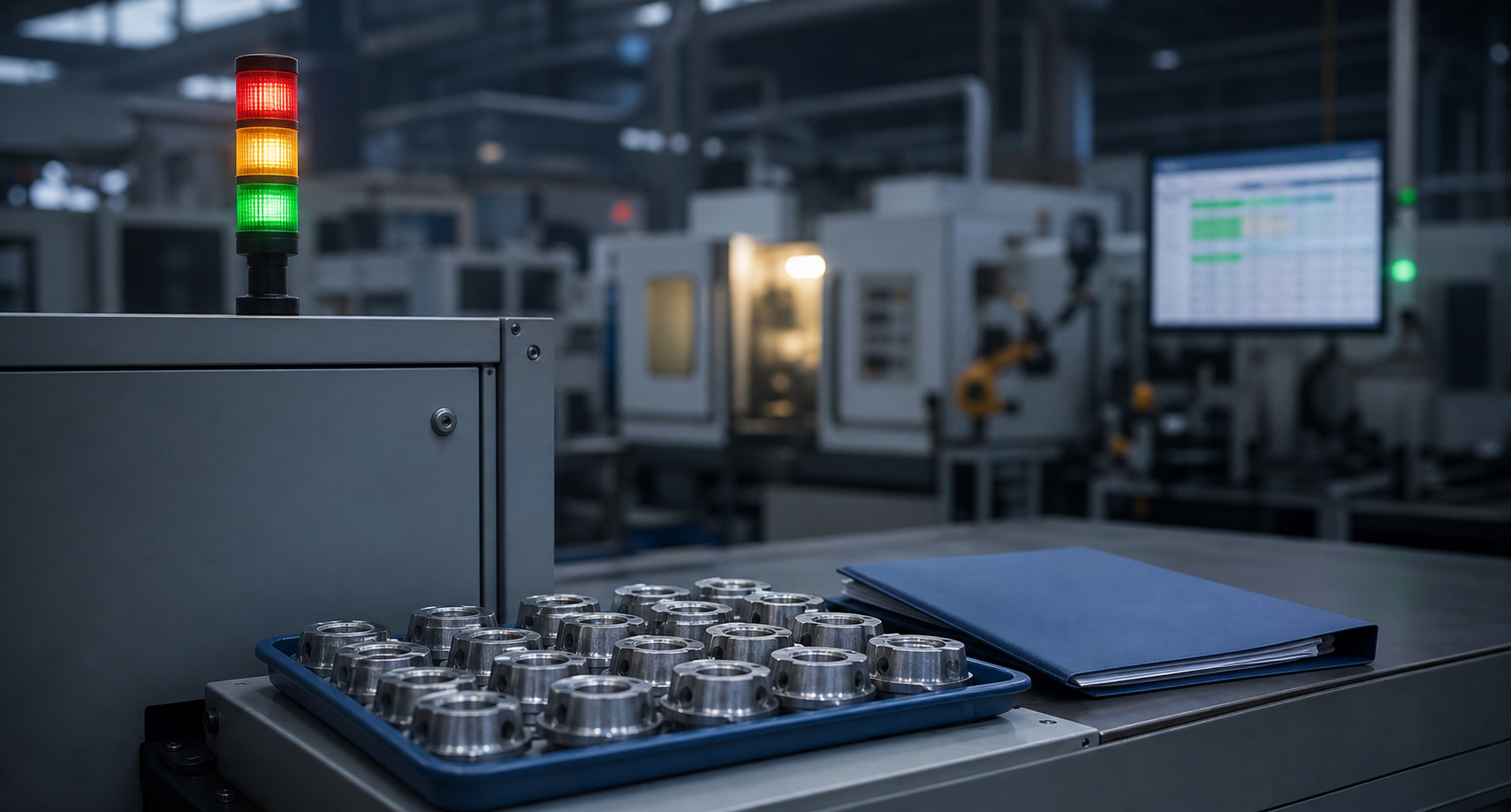
At 10:20 a.m., more than 100 machine-status changes appear at once on the shop-floor display: standby, alarm, speed loss, short stop, and automatic reset. The data refreshes almost every second, yet a rush order is still two hours behind schedule. The plant manager asks which machine is actually delaying delivery. Equipment checks the alarm ranking, production checks utilization, and planning checks operation progress. After switching through several screens, the team still cannot answer immediately.
This sounds counterintuitive. With more real-time data, shouldn't management be faster? The issue is that 'real-time' only indicates that information is transmitted quickly, not that the information has the necessary context for judgment, nor that someone has the authority to act on it. As data refresh speeds continue to improve, if decision subjects, responsibilities, and actions are not designed together, the shop floor may be pulled along by more changes.
1. The Equipment Signal Is Fast, But the Business Problem Is Not the Equipment Signal
Equipment can report its status in milliseconds or seconds, but what factory owners truly care about is usually a different type of question: which order will be late, which batch of products has quality risks, which bottleneck machine needs priority repair, whether to switch lines, insert an order, or adjust commitments.
A 'three-minute downtime' signal itself cannot answer these questions. It could be due to planned material changeover, operator absence, quality inspection, equipment protection, or missing parts from the previous process. The same three minutes, occurring on a regular machine may have no impact, but occurring on the only bottleneck machine of the day could change the entire order's delivery.
Therefore, equipment data only becomes usable information for judgment when it is connected to products, work orders, processes, shifts, personnel, and quality status. Faster data collection without establishing these relationships only makes managers see a pile of unexplained changes earlier.
2. Real-Time Without Context Creates Three Illusions
The first misconception is that more red alerts mean more serious problems. Many devices display short stops, automatic resets, and actual failures as alarms, leading the shop floor to chase the device with the most alerts, while ignoring the one that has the greatest impact on delivery.
A second misconception is that higher utilization means healthier production. Machines running continuously may be processing non-priority orders or piling up in-process inventory before the next bottleneck. Faster single-machine speed does not necessarily speed up the entire delivery chain.
A third misconception is that once data is displayed on the screen, responsibility becomes clear. In reality, the screen only shows information. Who acknowledges the issue, how quickly they respond, what situations require escalation, and who has the authority to stop the line or change the plan are all organizational rules. Without these rules, real-time dashboards merely allow more people to see the same problem at the same time.
In practice, job roles will adjust their behavior accordingly. Equipment personnel may tend to attribute alarm causes to operator errors to avoid being held responsible; production may prefer to wait for automatic recovery to avoid impacting delivery performance; and team leaders, seeing red lights without the authority to mobilize resources, may choose the safest action, which is to continue reminding in the group chat. Those who actively take ownership often end up doing more and making more mistakes, while those who do less and make fewer mistakes can pass the problems on. Red lights are difficult to close; the more transparent the information, the faster self-preservation behaviors may occur if authorization, handling, escalation, and responsibility boundaries are still mismatched.
3. Judgment Slows Down Often Because the System Is Organized by Data Source
Many factories have screens divided by system: the equipment platform shows status, the production system shows work orders, the quality system shows inspection results, and the warehouse system shows material status. Each system can update in real time, but shop-floor, answering whether an order can be delivered still requires manually piecing together information from four different screens.
Real decisions usually revolve around specific objects rather than systems. Team leaders care about the current process, workshop supervisors care about orders and bottlenecks in the next few hours, and managers care about customer commitments and resource allocation. The same data, at different time scales, requires different aggregation methods and responsible parties.
If a single screen serves operators, equipment supervisors, planners, and managers, it may include all indicators but fail to support any specific action. Real-time data needs not a larger screen, but clearer users and shorter action chains.
4. Each Real-Time Dashboard Must Answer Four Questions First
First, confirm who makes decisions and at what time scale. The team leader responds during shifts, the workshop supervisor coordinates across processes, and the plant manager makes resource decisions. These different time scales should not be merged into a single dashboard.
Second, verify what business impacts trigger the red alerts. Equipment alarms can serve as initial events, but management alerts should further consider bottlenecks, orders, quality, and expected recovery to avoid all changes competing for the same attention.
Third, clearly define who takes ownership and how long feedback is expected. Without responsibility and deadlines, colors are just reminders; without escalation paths, frontline staff can only repeatedly prompt.
Finally, use a checklist to ensure the system can trace back to original facts from conclusions. The system can first inform the plant manager that an order has a delay risk, but it must also allow visibility into which process, equipment, batch of materials, or pending inspection caused the impact, avoiding comprehensive scores becoming new black boxes.
These four questions come before "how many more machines to install." First define the decision, then determine what data is needed, how frequently it should update, how it should be connected, and who should use it.
5. The Value of Real-Time Lies Not in Faster Display, but in Faster Closed-Loop
Small, loosely managed factories may not need a second-level platform. First, place key equipment, urgent orders, and unresolved anomalies on the same shift dashboard, which is often more effective. Medium-sized growing factories should focus on unifying the relationships between equipment, work orders, quality, and materials to reduce cross-system integration. Large or maturely managed factories should govern alarm rules, metric definitions, and permissions to prevent attention from being consumed by low-value events as data scale expands.
the factory owner can conduct three random checks per week and hold a retrospective: how long did it take from signal occurrence to someone acknowledging ownership, what contextual information was missing from acknowledgment to decision-making, and whether the problem was truly resolved after the decision. If data has already arrived but actions remain delayed, the bottleneck is not in data collection speed.
Connecting equipment certainly has value, and real-time data is not inherently wrong. The real misunderstanding lies in equating 'receiving data faster' with 'making correct decisions faster.' shop-floor management requires a complete chain from signal to context, from context to responsibility, and from responsibility to action. If the chain is not well designed, the more real-time the data, the more real-time the noise; shortening the chain, even if updates occur only by the minute, can be closer to operational outcomes than a seconds-level dashboard.
I am Huang Chaoxing, inventor of the TreeMES stack-light MES system. Follow me for ongoing analysis of shop-floor management and digital transformation trends in manufacturing.
