
How to Manage Mold Life: Track Cycles, Repair Conclusions and Retirement Limits
Many factories' mold records appear complete with purchase dates, asset numbers, and maintenance cycles. However, when cycle counts approach the lifespan and the same defect recurs, operators still ask experienced technicians: 'Can this mold still be used?'
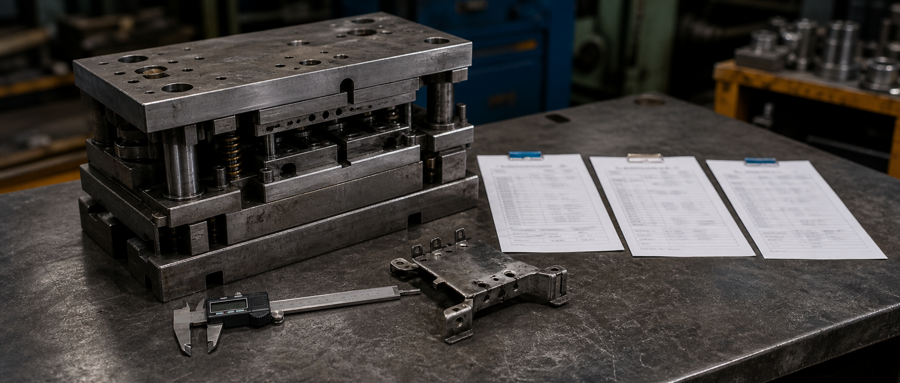
Many factories' mold records appear complete: purchase date, asset number, and maintenance cycle are all recorded. However, when the number of strokes approaches its lifespan and the same defect recurs, the shop floor can only ask the experienced technician, 'Can this mold still be used?'
What owners truly fear is not missing a single number, but when a mold should be repaired, downgraded, or retired, no one can make a decision based on the same set of facts. Continuing production risks quality control, while early retirement risks delivery and cost issues.
Mold life is not a fixed countdown. Material, speed, lubrication, repair methods, and product tolerances all affect it. Rather than pursuing a seemingly precise lifespan value, it is better to connect the three records together.
Track What Has Been Experienced
Do not just accumulate total strokes. At least record usage intervals by product, material batch, production speed, and key operating conditions, and pair them with changeovers, abnormal shutdowns, and overloading with corresponding stroke counts.
If the equipment can automatically collect data, the metric definition should still be retained: is it counting slider strokes, conforming parts, or actual forming strokes? The three numbers have different meanings, and mixing them together creates false precision.
shop-floor handover requires answering three questions: how much effective usage was added during the shift, what anomalies occurred during the period, and what should be closely monitored in the next shift. This ensures that usage counts become part of the context rather than just a monthly summary figure.
Record What Has Changed
Each repair should clearly document the fault manifestation, location of discovery, actions taken, and retest results. More importantly, distinguish between 'restored to original condition,' 'temporary repair,' and 'structural or clearance modification.' These three conclusions correspond to different levels of observation intensity.
According to the U.S. Department of Energy's maintenance best practices, predictive maintenance should identify trends before obvious deterioration occurs. However, technology only has value when it is correctly applied, consistently implemented, and combined with personnel training. Purchasing inspection tools does not mean maintenance decisions are already closed.
If the same defect reoccurs after repair, the system should retrieve the previous conclusion to allow the technician to determine whether it is a recurrence of the old issue, a chain reaction from adjacent areas, or a new operating condition triggering the problem. It should not start from a blank work order each time.
Determine When to Stop Using
Boundaries should not only state 'reached design life.' They should also set quality, condition, and management boundaries, such as continuous approach to control limits for critical dimensions, repeated occurrence of similar repairs, missing critical spare parts, or temporary repairs exceeding allowed duration.
Each boundary must correspond to a handling action and clearly define who accepts the work order, who transfers it, and who has the authority to escalate or close it. Otherwise, frontline staff may fear line stoppage responsibility, maintenance personnel may feel that mass production 'does not belong to them,' and even if they know there is risk, they may continue working.
NIST's maintenance evaluation materials remind that condition monitoring should be viewed alongside part quality, output, equipment health, and resource usage. Focusing solely on fault prediction accuracy cannot automatically inform the factory when to stop, how to stop, and how to maintain delivery after stopping.
Implementing Three Records in One Week
First, factory owners should select a mold with recent frequent anomalies and standardize the cycle definition. Second, verify the conclusions from the last three maintenance events. Third, production, quality, and maintenance teams should jointly define three categories of shutdown boundaries.
Run the mold continuously for one week, recording only necessary facts per shift. Conduct a weekly review: identify unused fields, boundaries that trigger without action, and decisions still made verbally. Remove ineffective fields and ensure missing authorizations are added.
Not all factories need complex systems. Small factories can start with shared tables, medium-sized factories can connect equipment, work orders, and quality records; mature factories should focus on verifying cross-departmental authorizations. The three ledgers must point to the same mold identity.
The value of mold life management lies not in calculating each mold to its last cycle, but in enabling the shop floor to make decisions to continue, repair, downgrade, or stop based on evidence before quality loss occurs.
I am Huang Chaoxing, inventor of the TreeMES stack-light MES system. Follow me for more practical factory-management methods.
