More Connected Machines—Why Does Downtime Diagnosis Still Depend on Experienced Technicians?
A production line is connected to vibration, temperature, current, and alarm data. When a machine stops, the large screen displays dozens of signals simultaneously. However, upon arrival of maintenance personnel, they still wait for the experienced technician to listen to the sound, feel the temperature, and judge based on experience where to start the inspection.
Why Does Downtime Diagnosis Still Depend on Experienced Technicians Despite More Connected Machines?
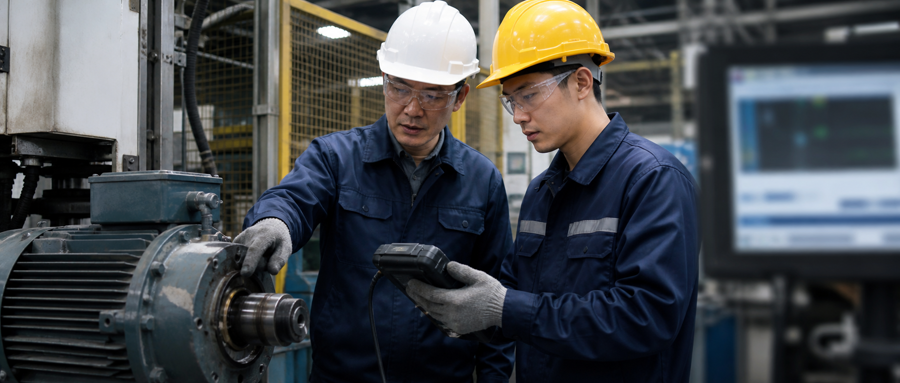
A production line is connected to vibration, temperature, current, and alarm data. When a machine stops, the large screen can simultaneously display dozens of signals. However, when maintenance personnel arrive, they still wait for the experienced technician to listen to the sound, feel the temperature, and make a judgment based on experience to determine where to start the inspection.
the factory owner often interprets this as 'employees don't know how to use data.' But more commonly, the truth is that the system collects what happened with the equipment but does not retain why the technician made a judgment, what actions were taken, and whether the judgment was correct.
Connecting equipment solves the problem of seeing signals, but downtime diagnosis requires connecting signals, operating conditions, mechanisms, actions, and results into knowledge. The gap is not a large screen, but a mechanism for continuously reusing judgment.
Data Is Becoming More Complete, But Context Is Often Lost
An increase in temperature has different meanings during high-speed operation, after a material change, or due to lubrication issues. If the system only stores time and value without product, speed, load, and maintenance actions, the maintenance technician sees only a curve detached from the actual situation.
NIST's research on smart manufacturing knowledge management distinguishes data, information, and the understanding of 'why.' Sensors can provide raw data, but to support decision-making, they must link workpieces, tools, materials, processes, and equipment performance.
Data is stored on the equipment platform, work orders are in the maintenance system, quality results are in inspection records, and the experienced technician's judgment remains in chat logs. None of these pages can fully reconstruct the entire downtime process.
The Value of a Master Craftsman Should Not Be Reduced to a Single Reason
Experienced technicians first eliminate hazards and then examine sounds, load, and recent maintenance before and after the downtime, adjusting the inspection sequence based on similar experiences. The real value lies in the troubleshooting path, not just 'bearing failure'.
If a work order only allows selecting one fault code, it flattens the reasoning process. When similar signals occur again, new technicians still don't understand why lubrication is checked first or why disassembly is temporarily avoided.
Experienced technicians are becoming increasingly irreplaceable not because of digital failure, but because the system treats them merely as conclusion providers, without converting their judgment process into reviewable and updatable organizational knowledge.
Record Three Types of Relationships First, Then Discuss Intelligent Diagnosis
First, connect signals with operating conditions. When an alarm occurs, bring up product, speed, load, shift, and recent changes to place the signal back in its real context.
Second, connect judgment with action. Record what was checked first, what was ruled out, and why a particular step was taken, so that the next person can understand the troubleshooting sequence.
Third, connect action with results. Verify whether production was restored, whether quality remained stable, and whether the issue recurred. Without result feedback, incorrect experiences may be retained.
NIST's documentation on smart manufacturing system integration indicates that different specialized models and tools often express information redundantly and inconsistently. Connecting interfaces is just the first step; unifying objects, semantics, and contextual judgment can reduce manual integration.
What Burden Will Digitalization Really Reduce for Experienced Technicians?
It is not about diminishing the importance of experienced technicians, but rather reducing their need to repeatedly search for data, explain similar faults, and take responsibility for verbal judgments. Acceptance, transfer, handling, escalation, and closure should all be documented. Common procedures should be handed over to newcomers, while complex exceptions should remain under experienced judgment.
Factory owners can start with the top three most frequent types of downtime, preserving one diagnostic chain each time. Medium-sized factories should unify equipment, work orders, and quality objects, while mature factories should regularly eliminate outdated rules.
Such factories should clearly define permissions, responsibilities, benefits, risks, and collaboration boundaries: repair personnel have the authority to request downtime, team leaders bear responsibility for production output and receive escalation authority, newcomers do not need to avoid judgment through self-protection, and quality positions are willing to cooperate in rechecking.
Not all factories need to build a knowledge base first. Some should prioritize improving equipment foundational capabilities; however, for factories with frequent downtime, retrospective reviews can assess whether newcomers can more quickly identify the correct sequence.
The endpoint of equipment connectivity is not more data, but fewer blind disassemblies shop-floor and fewer repeated trial-and-error attempts, allowing correct judgments to no longer depend solely on an individual's shift.
I am Huang Chaoxing, the inventor of the TreeMES stack-light MES system. Follow me for ongoing analysis of shop-floor management and digital trends in manufacturing.