
Maintenance Is Scheduled—Why Does Downtime Still Wait for One Spare Part?
At 8 a.m., a line stops for scheduled maintenance. After opening the gear reducer, the maintenance technician discovers that the stocked oil seal is two millimeters off specification, leaving the production crew waiting while procurement contacts the supplier.
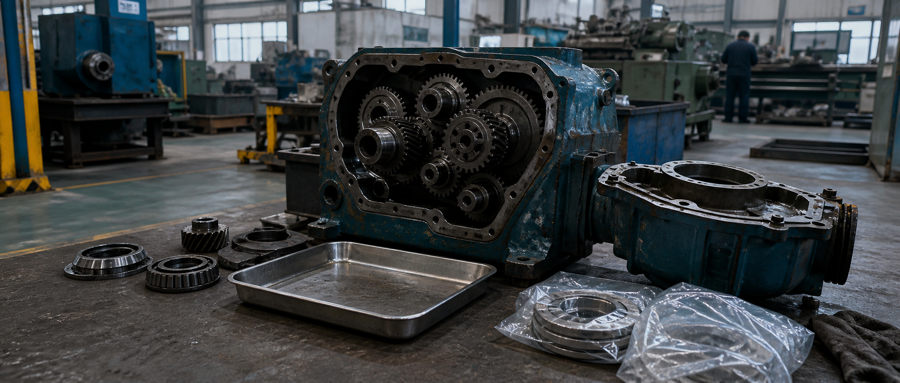
At 8 a.m., the line stops for scheduled maintenance. After opening the gear reducer, the maintenance technician discovers that the oil seal in stock is two millimeters off specification. Procurement begins contacting the supplier while the production crew waits beside the stopped equipment, and the planned two-hour window quickly extends.
What the factory owner finds hardest to accept is: the maintenance work order was scheduled a week in advance, the system shows the spare parts are in stock, so why is there still a wait on site? The problem is usually not about whether there is a plan, but the plan only schedules a time without verifying whether the job can actually start.
A complete spare parts kit is not just a stock quantity greater than zero. It must also prove that the part is the correct identity, in a usable condition, in a retrievable location, and has been reserved for this work order.
When the Plan Was Issued, Three Positions Saw Different Things
What the equipment supervisor sees is the maintenance cycle and the downtime window; what the warehouse sees is the material code and the inventory quantity; what the maintenance technician really needs is a physical part that is compatible with this equipment, this location, and the current version.
The same generic name may correspond to different sizes, materials, or interfaces. Having one item in stock does not mean it can be installed; being installable does not mean it has been checked for aging, moisture, expiration, or being occupied by another work order.
A key spare parts audit by the U.S. Department of Energy pointed out that complete management is not just about knowing the inventory quantity, but also about clearly identifying which parts are needed for critical equipment, the required stock levels, replenishment points, and storage locations. Without object relationships, more inventory does not necessarily mean greater reliability.
Check After Disassembling the Phone, the Waiting Time Has Been Locked
shop-floor practices often leave spare part verification to maintenance personnel. Maintenance technicians can only identify the part model after disassembling the equipment; warehouses are reluctant to pre-reserve parts due to fear of errors; equipment supervisors bear the responsibility for downtime but lack the authority to freeze inventory.
The result is that everyone is protecting themselves: maintenance personnel fear making more mistakes by doing more work, and warehouses opt for fewer actions to minimize errors. Orders are only acknowledged, transferred, processed, escalated, and closed after the part is missing, delaying the exposure of discrepancies until downtime occurs.
The NASA Reliability Center Maintenance Guide lists part availability, maintenance capability, specialized tools, and technical documentation as essential conditions for ensuring reliability. The presence of spare parts is just one aspect; the true goal is to ensure that maintenance actions can be completed continuously.
Advance Confirmation of Start of Work to the Day Before Shutdown
The first step is to identify the equipment. Work orders must include the equipment, location, manufacturer part number, version, and allowed substitution relationships, rather than simply stating 'one oil seal' or 'one bearing.'
The second step is to verify the physical condition. Warehouses take photos of the part number, specifications, storage condition, and location; maintenance personnel confirm remotely. For critical parts, they may be retrieved in advance to avoid discovering the wrong part on the same day.
The third step is to bind operational resources. Parts, specialized tools, drawings, personnel, and downtime authorization must all be available for the work order to transition from 'planned' to 'ready to start.' Missing any one item requires rescheduling the window, preventing the production line from waiting idly.
The U.S. Department of Energy maintenance guidelines also require work packages to list specialized tools and parts, with pre-job checks and pre-allocations. When no equivalent spare parts are available, engineering personnel should make the judgment rather than attempting temporary installation shop-floor.
Focus on One Key Piece of Equipment First, Rather Than Spreading It to the Entire Factory
Not all factories require complex systems. Small factories use photos and shared tables for verification, medium-sized factories connect equipment lists, inventory, and work orders for pre-reservation, while mature factories manage substitute part approvals and version changes.
Factory owners can forward checklists to plant managers and equipment supervisors, focusing on three key metrics weekly: how long three types of spare parts are waiting, how many discrepancies are identified before downtime, and who has authority to cancel a maintenance task that lacks readiness.
The true sign that a maintenance plan is properly scheduled is not a calendar window, but the ability of maintenance personnel to complete tasks continuously upon arrival. Moving spare part confirmation from 'available in inventory' to 'available shop-floor' ensures downtime is not spent searching for a single part.
I am Huang Chaoxing, inventor of the TreeMES stack-light MES system. Follow me for insights into the management logic behind frontline stories in manufacturing.