Faster Accountability—Why Root Causes Collapse into ‘Operator Error’
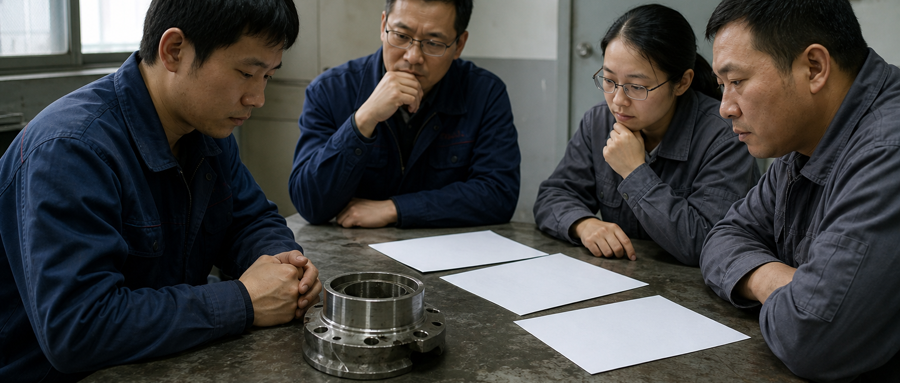
A product dimension is out of specification. Within ten minutes, the meeting record says the operator failed to confirm as required, without asking how the incorrect action passed through the program, equipment, and inspection controls.
Why Rapid Accountability Leads to 'Operator Error'
A product dimension is out of specification. In less than ten minutes, the meeting record concludes that the operator failed to confirm as required. No one asks how the incorrect action passed through the program, equipment, and inspection controls.
Quickly assigning responsibility can stabilize emotions but may prematurely close an investigation. When the conclusion is solely 'operator error,' the easiest fixes are retraining and re-signing, while deeper issues like authorization, cycle time, interface design, and error-proofing remain untouched.
Effective accountability is not about eliminating blame but first distinguishing between unintentional errors, system gaps, and intentional violations before deciding who is responsible for what improvements.
People Are the Link Closest to the Result, Not Necessarily the Start
An operator may input the wrong parameter due to similar names, compressed changeover time, absence of approvers, or the availability of an old recipe. If the investigation only asks 'who last touched the equipment,' the answer naturally stops at the frontline.
The FAA compliance program emphasizes identifying safety issues behind standard deviations through collaboration, root cause analysis, transparency, and information sharing. It also involves examining the conditions that make errors more likely and harder to detect promptly.
High-reliability organizations acknowledge that people make mistakes and therefore design barriers to prevent, detect, and mitigate consequences. Simply requiring employees to 'be more careful next time' places all control on the continuous perfection of individuals.
Accountability Pressure Alters Field Information
Operators may omit hesitation, last-minute instructions, and near-miss errors due to fear of penalties. Shift supervisors, focused on output, may emphasize individual execution. Equipment, process, and quality departments may each prove their own areas are faultless. The faster meetings attempt to assign blame, the more likely information becomes self-protective material.
FAA policy distinguishes between accountability for future improvement and blame for past punishment. It advocates for non-blaming analysis of unintentional errors while clearly defining boundaries for intentional or unacceptable behavior.
This is not leniency. Intentionally bypassing critical controls when rules are known and conditions are met should be handled according to clear boundaries. If procedures are unimplementable, authorization is insufficient, or systems allow silent bypassing, management must take responsibility for remediation.
Investigations must be accepted, transferred, handled, escalated, and closed. If only the quality department is held accountable, there is no change in production and technical performance, leading to reduced effort and fewer errors across departments. Binding permissions, responsibilities, and verification results is necessary to prevent each position from focusing solely on self-protection.
Shift Investigation Order from 'Finding People' to 'Restoring Conditions'
First, establish the facts. Reconstruct the product, equipment, parameters, personnel, and inspection records in chronological order, without drawing responsibility conclusions yet.
Second, examine barriers. Ask sequentially where the error could have been prevented, reminded, intercepted, or detected at each step, and why those measures failed to function at the time.
Third, listen to the true decision. Have the involved party explain what they saw, what they were asked to do, what they were worried about, and what consequences they would face if they stopped the machine.
Fourth, assign responsibility. Address honest mistakes, lack of capability, process defects, management trade-offs, and intentional violations separately, clearly defining actions, responsible parties, deadlines, and verification methods.
What Factory Owners Want to See Is Whether Recurrence Risk Has Decreased
Medium-sized growing factories are most prone to having established roles but incomplete authority: quality is responsible for results but lacks the power to stop the line, while team leaders are accountable for delivery but cannot get timely support. Frontline staff will eventually choose to say less, act faster, and protect themselves.
In small, loosely managed factories, the priority is to ensure that anomalies reach the factory owner directly; in mature factories, the focus is on preventing rigid boundaries of responsibility. Not all factories apply the same investigation form, but they should distinguish between honest mistakes, system gaps, and intentional violations.
Factory owners can forward the requirements to plant managers, shop floor supervisors, and team leaders: each incident report should at least include one individual action, one shop-floor condition, and one system barrier, and the measures should be verified within a week to confirm whether they effectively prevent similar errors. If only training and punishment continue, it indicates that the investigation has not touched the system.
Accountability can be fast, but root cause analysis cannot be rushed. Use responsibility to drive repair, not to end the discussion quickly. Only then can the factory gain a more reliable process from a single mistake, rather than a seemingly complete penalty sheet.
I am Huang Chaoxing, inventor of the TreeMES stack-light MES system, and I focus on analyzing shop-floor management and digitalization trends in manufacturing.