
After AI Inspection Goes Live, Management Should Look Beyond Detection Rate
After AI inspection is deployed, management should look beyond detection rate. A production line equipped with visual quality inspection shows a rapid increase in defect detection rates in reports, yet the quality department becomes busier: the rejudgment queue grows longer, the rework area continues to accumulate materials, and the same scratch reappears next week.
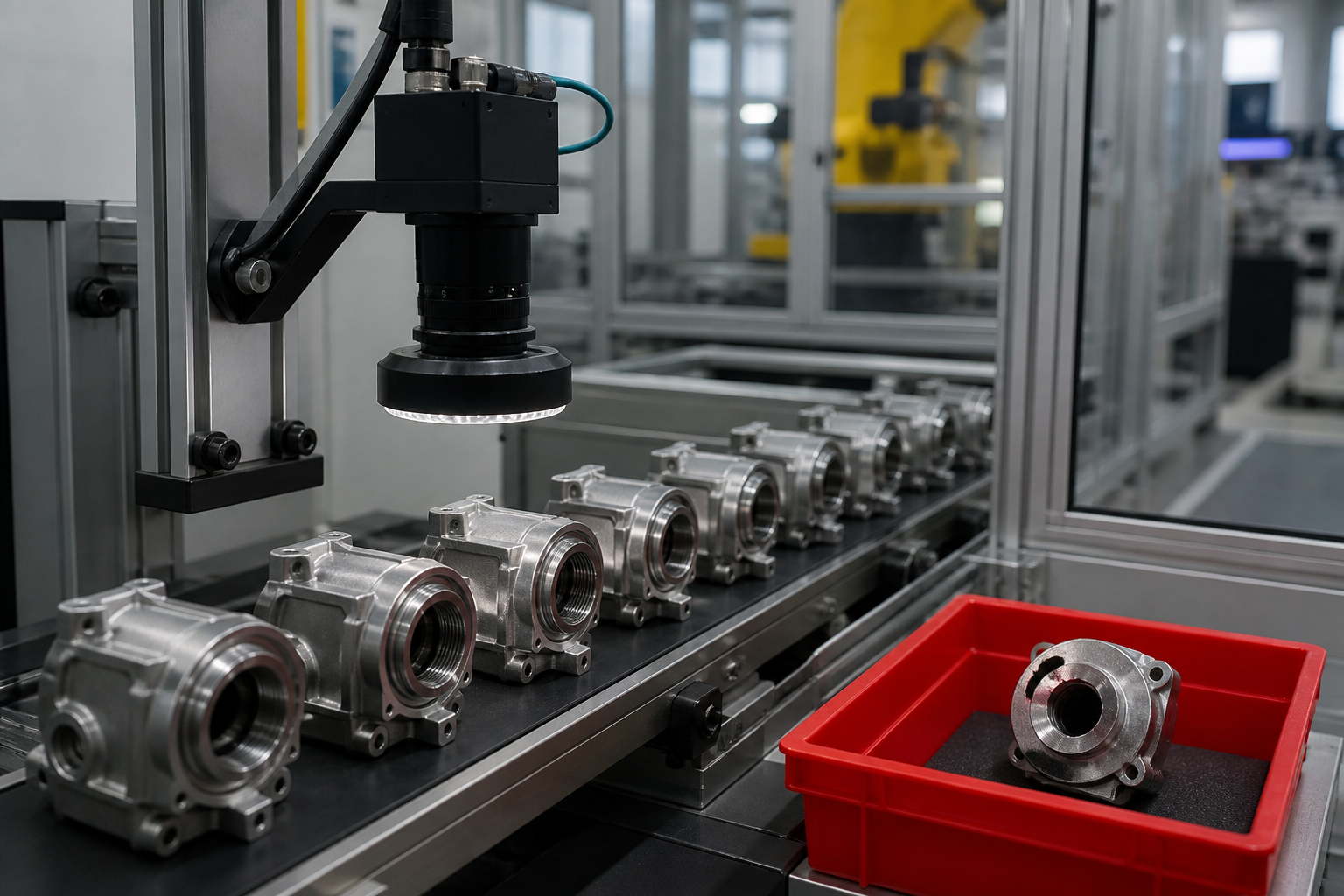
After AI quality inspection goes live, what management should focus on is not the detection rate
After a production line is equipped with visual inspection, the defect detection rate in reports rises quickly, but the quality department becomes busier: the re-evaluation queue grows longer, and the rework area continues to accumulate materials. The same scratch reappears next week.
If management only asks about how many defects the model detects, they may mistake 'seeing a problem' for 'solving it.' The value of AI vision lies not in drawing more red boxes, but in whether it can drive isolation, handling, root cause analysis, and prevention into a closed-loop process.
This judgment is mainly for factory owners. Owners should look at quality costs and delivery risks and forward the inspection method to plant managers, shop floor supervisors, and team leaders, requiring each position to review using the same defect record.
The detection rate only answers the first question
NIST's introduction to AI in manufacturing points out that machine learning and computer vision can identify subtle defects or anomalies, but it also lists obstacles such as data quality, skills, costs, and integration with legacy systems.
This means a high detection rate can only indicate that the recognition process may be more sensitive. It does not answer whether false alarms are consuming re-evaluation personnel, nor does it address the risk of missed detections, stoppage rules, rework capacity, and whether root cause improvements are changing in sync.
After the red box, responsibilities still need to be implemented
A defect image must connect at least five actions: physical isolation, defect re-evaluation, impact range judgment, responsibility assignment, and result feedback. If any step is broken, AI merely accelerates the creation of pending tasks.
In mid-sized growing factories, a common issue is that algorithms are managed by the technical department, re-evaluation by quality, and root cause by production. Each department's metrics may look good individually, but no one is accountable for the total time from defect occurrence to closure.
As false alarms increase, operators may look for ways to bypass the rules; when the quality department cannot re-evaluate in time, pending items will fill the shop floor; when production only sees deductions, defect labels will gradually become ambiguous.
Team leaders are responsible for accepting orders, quality for handling and escalation, and technical staff for closing defects. If those who actively expose problems are always held accountable, the shop floor will develop a self-protective mindset of doing more leading to more errors and doing less leading to fewer errors.
Therefore, management should first clarify: who has the authority to stop the line, who can reclassify defects, who is responsible for adding samples, who approves model or threshold changes, and who decides the release boundary when disputes cannot be resolved.
Use three types of indicators to replace single-point showcasing
The first step is to assess risk: missed detection rate for critical defects, false alarm rate, re-evaluation consistency, and whether the system reliably transfers to manual when the model cannot decide. Defects of different severity levels cannot be masked by an average accuracy rate.
The second step is to evaluate flow: how long it takes from detection to isolation, from isolation to re-evaluation, and whether the number of in-process items in hold and rework is decreasing. Identifying faster but making the queue longer means the system's value is negative.
Third, assess improvement: has repeated defects decreased, are the root causes and corrective actions addressed on time, and does the model's findings drive improvements in process, equipment, materials, and training?
NIST's approach to evaluating industrial AI investments starts by determining whether monitoring covers real risks and whether those risks can be mitigated, then comparing baseline risk, operational costs, tool risk, and business value.
It is more suitable for mid-sized growing factories where data volume has increased but responsibility boundaries remain unclear. Small factories can start with manual closed-loop processes, while large or mature factories should manage model changes. Not all defects are suitable for AI.
Perform closed-loop sampling once a week
Randomly select ten AI defect records and trace them from images to physical items, re-evaluation, handling, root causes, and preventive actions. If any record loses its object identity or responsibility in the process, it is recorded as a closed-loop break point.
Then select defects found by manual inspection but missed by AI to determine if they result from sample gaps, changes in imaging conditions, new process anomalies, or unclear classification rules. Incorporate these feedbacks into controlled updates to prevent the model from drifting silently in the field.
Finally, evaluate quality costs: have scrap, rework, re-inspection, line stoppages, and customer complaints changed? Detection rate can be a technical metric, but only a reduction in systemic risk and losses is a gain that management should recognize.
I am Huang Chaoxing, inventor of the TreeMES stack-light MES system, and I focus on analyzing shop-floor management and digitalization trends in manufacturing.
