
How to Prevent Line-Side Leftovers from Accumulating: Track Container, Batch, Operation and Status
A completed order leaves half a box of screws, two rolls of labels, and an opened bucket of auxiliary materials on the line. The team says the next order might still need them, the warehouse refuses to accept without batch and quantity information, and the planner continues to count the remaining inventory as available. A few days later, when a new order is issued for material withdrawal, the system shows sufficient inventory, but the specific box that should be used cannot be found on site.
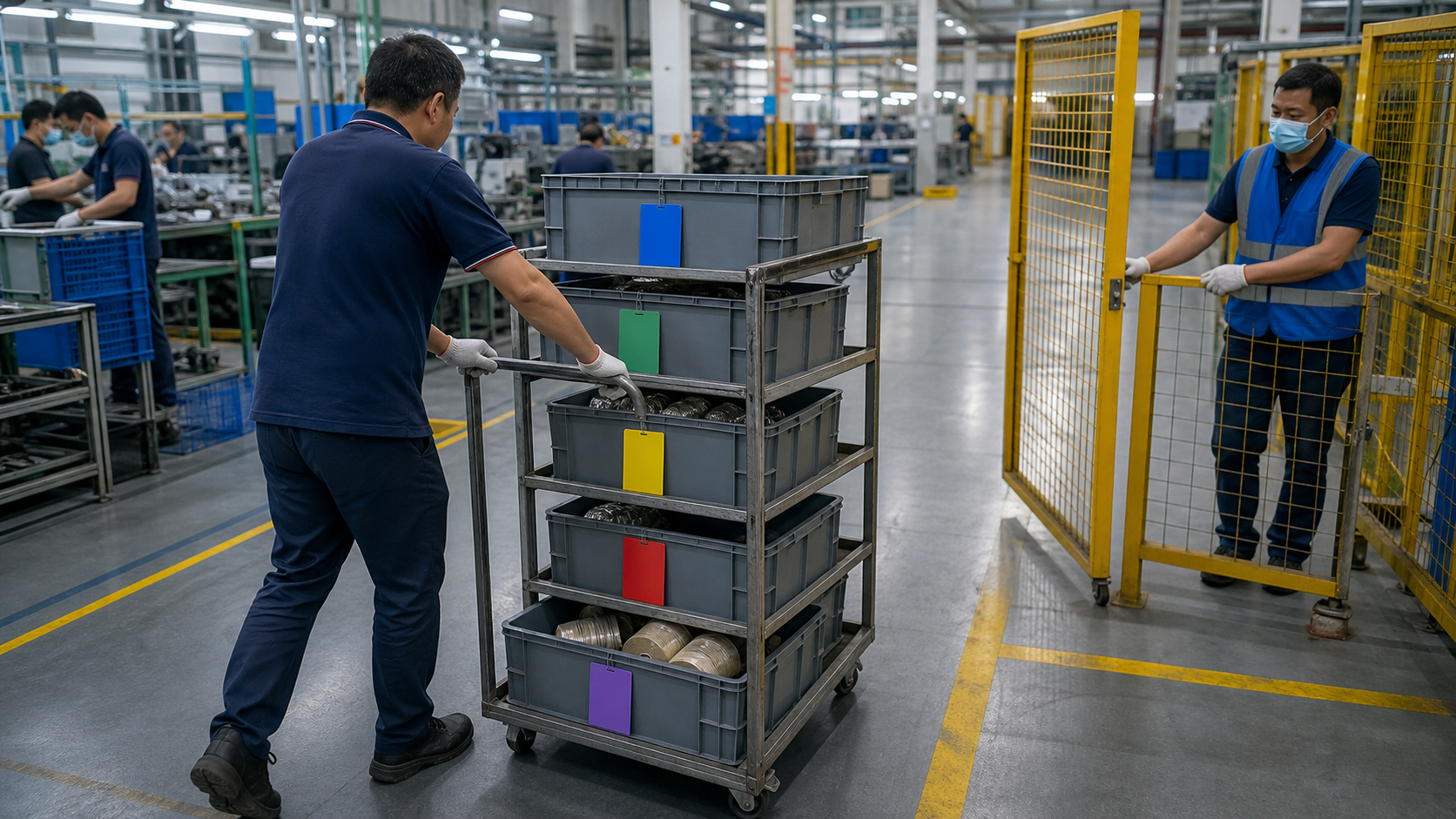
After completing an order, leftover items such as half a box of screws, two rolls of labels, and an opened bucket of auxiliary materials remain on the line. The team says the next order might still need them, the warehouse refuses to accept them without batch and quantity information, and the planner continues to count the remaining inventory as available. A few days later, when a new order requires materials, the system shows sufficient stock, but the specific box cannot be found on site.
Leftover materials accumulate not because workers are reluctant to return them, but because there is a lack of actionable information before physical return. Simply writing the material name is insufficient for the warehouse to determine which batch it belongs to, which operation it has undergone, and whether it is still usable. Matching the four columns of container, batch, operation, and status first ensures that leftovers have a clear destination.
This method is primarily suitable for discrete manufacturing sites with multiple product varieties, small batch sizes, and frequent changeovers. The goal is not to add a complex table, but to ensure that each leftover can be identified, moved, reused, or isolated.
Factory owners must also recognize the incentives: the team fears responsibility for returning incorrect materials, and the warehouse says 'it's not my responsibility,' unwilling to accept orders. Leftovers remain untransferred, unescalated, unprocessed, and un-closed, with both parties choosing self-protection.
1. Container: Assign a unique location to the physical item
The same material may be stored in three different returnable containers, with only the total quantity recorded. After one move, the correspondence may be lost. Each box, roll, bucket, or pallet must have an identifiable container number, associated with the current quantity and location.
Container numbers are not intended for individual serialization. Low-risk generic parts can be managed by container, while high-risk or easily mixed materials should be tracked down to batch or individual units. The level of identification should match the quality risk and traceability risk after misuse.
2. Batch: Retain its origin
Residual material labels should at least include material number, batch, original order, or material source. When unpacking, splitting reels, or repackaging, the original batch relationship must be carried over, not just copying a product name.
If two batches with identical appearance are mixed into the same container, subsequent record-keeping cannot reliably reconstruct the situation. When encountering residual materials with unclear identity, they should be transferred to a pending confirmation area and not directly merged just because they 'look the same'.
3. Process: Document what it has undergone
The usage conditions for the same material may differ across the warehouse, preparation area, machine-side, and rework area. Recording the last process it was in can help the warehouse determine whether it has been opened, exposed to heat, contacted oil, or has crossed into the quality boundary of a specific order.
4. Status: Keep only words that determine the next step
It is recommended to compress the status into five categories: returnable, pending confirmation, limited use, isolated, and scrapped. Each status should correspond to the next action, responsible role, and completion deadline, avoiding descriptions like 'already handled' or 'to be addressed later' that cannot be executed.
Returnable materials must confirm packaging and quantity; pending confirmation should clearly state what evidence is missing; limited use must specify the order or time frame; isolation and scrapping must move the material out of the usable area. A status cannot be considered closed unless it has not changed the physical location of the material.
5. After line change, review the four columns
First, count each container individually and apply an identifier. Second, verify the batch and original order. Third, record the last operation and storage conditions. Fourth, select the status and hand it over for confirmation by the relevant position. If any of the four fields are missing, place the item in the pending confirmation area.
Small factories can use durable labels combined with a return form. Medium-sized factories can integrate the container-batch relationship into the inventory system. Large factories should avoid having multiple systems tracking different statuses. Regardless of the tool used, the four fields must refer to the same physical item.
Not all low-value common parts require individual tracking. Some factories find container and batch information sufficient. The identification cost must align with the risk of misuse, traceability responsibility, and shop-floor benefits.
The key to scrap management is not clearing the line-side at the end of the month, but assigning each container an identity, history, and destination at the moment the order ends. When containers, batches, operations, and status match, the inventory on record can become actual usable inventory on the shop floor.
I am Huang Chaoxing, inventor of the TreeMES stack-light MES system. Follow me for more practical factory-management methods.
