
Can an Electric Forklift Return to Service after Charging? Check Four Things
When the warehouse is busiest, an electric forklift reaches full charge and the team wants to unplug it immediately. The ten minutes saved can conceal risks involving battery restraint, connector damage, incomplete vehicle inspection, and an ambiguous handover.
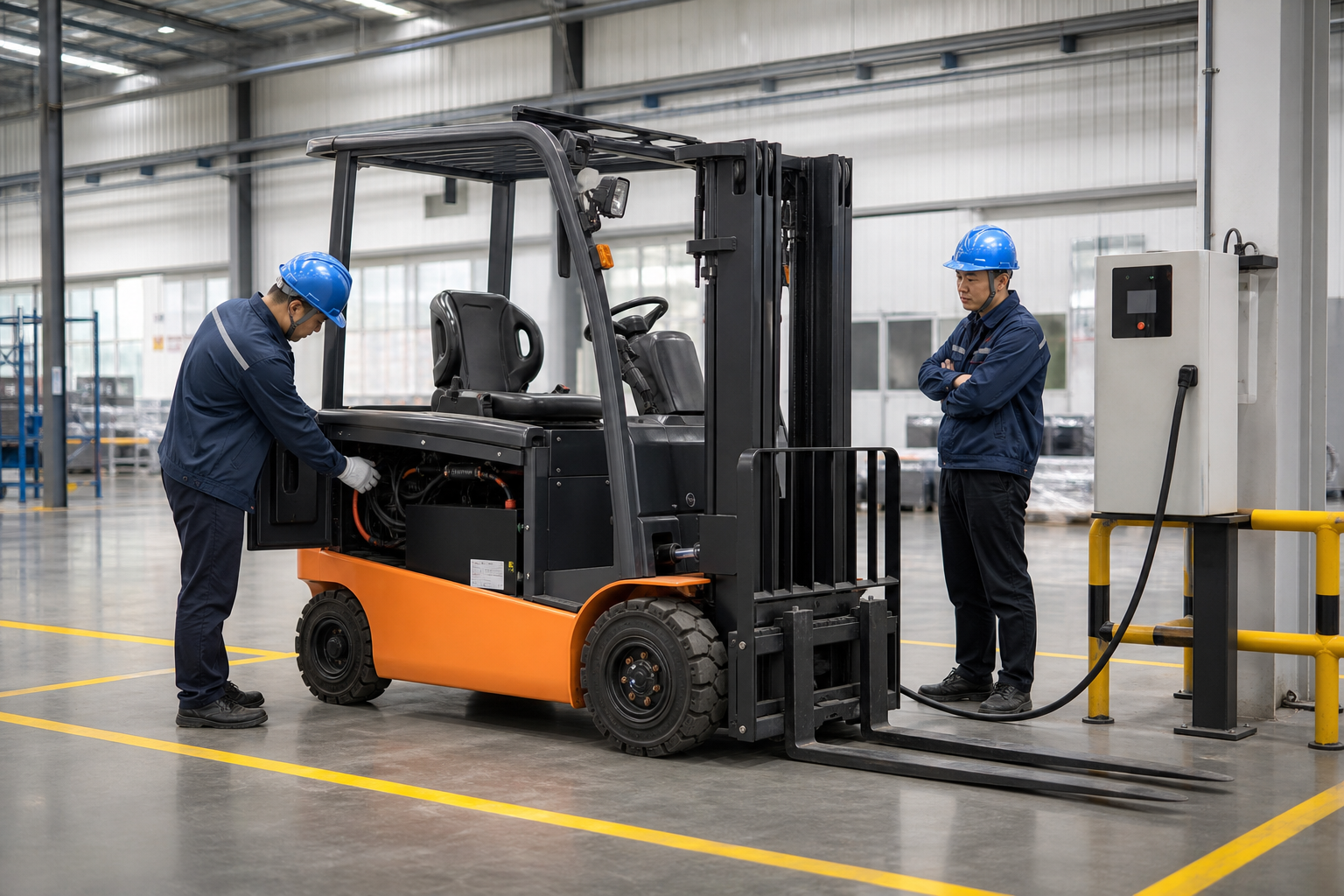
When the warehouse is busiest, an electric forklift reaches full charge and the team wants to unplug it and return it to service immediately. The ten minutes saved may conceal risks involving an unsecured battery, damaged connectors, an incomplete vehicle inspection, and an ambiguous handover such as ‘it’s ready.’
Completion of charging does not equate to the vehicle being ready for operation. The 'full' state should be separated from 'ready for use': the charger should complete energy-side checks, and the operator should complete vehicle-side checks, with a brief record of the handover.
The following checklist is a site management framework and does not replace local regulations, manufacturer manuals, or plant safety procedures. When handling electrolyte, live connections, or maintenance, only trained and authorized personnel should perform the work according to established procedures.
Check Battery Status
First, check if any abnormal conditions occurred during charging, such as overheating, unusual odors, leakage, swollen casing, or alarms. If any of these occur, the vehicle should not be put back into service even if the charge level appears normal. It should be isolated and handed over to authorized personnel for assessment.
Next, confirm that the battery or battery pack has been correctly reset and securely fastened, with the cover, locking mechanism, and ventilation ports in the specified condition. Since batteries are heavy, improper securing can affect equipment performance and amplify risks during turns, braking, or on slopes.
Check Connection Status
After the charger is turned off and disconnected according to regulations, inspect the cable, plug, and connection points for wear, exposure, burning, looseness, or mismatch. Just because the connection can be plugged in does not mean the connection quality is acceptable; temporary wrapping or forced connections should not be used in production.
The charging area must also be restored to a safe condition: charging cables should be returned to their proper place, the floor should be free of liquid accumulation and obstacles, and fire protection, ventilation, and cleaning facilities should be operational. This action protects the next charger and prevents the forklift from leaving with dangling cables or scattered items.
Check Vehicle Status
After the driver takes over the vehicle, perform a static inspection, focusing on the tires, forks, mast chains, protective devices, hydraulic leaks, nameplate, and battery restraints. Do not consider 'it worked yesterday' as today's inspection result; vehicles in continuous operation should undergo inspections according to shifts.
Subsequently, conduct a dynamic inspection in a safe area: check if braking, steering, forward and reverse movement, lifting and tilting, horn, lights, and reverse warning are functioning normally. If abnormal noise, vibration, delayed braking, or instrument alarms occur, the vehicle should be immediately taken out of service and reported.
Check Handover Facts
The handover record does not need to be complex, but it should answer four questions: who completed the charging, when it ended, what abnormalities were found, and who confirmed the vehicle is ready for operation. If maintenance or component replacement occurred, the handling conclusion and recheck person should be clearly recorded, not just a single statement 'already handled'.
It is recommended to classify the status into three categories: charging, pending inspection, and ready for operation. Vehicles not yet inspected should remain in 'pending inspection', and the key or electronic access should not be released. Abnormalities should be clearly documented with escalation, transfer, handling, and closure results to avoid the team mistaking the completion of charging for safe release.
This checklist is primarily applicable to mid-sized growing factories with dedicated warehouse and equipment positions. Small, loosely managed factories may have one person handling multiple roles, but inspections and confirmations should still be completed at different times. Larger or mature factories should align manufacturer requirements, maintenance authorization, and vehicle electronic permissions into a unified set of rules.
Factory owners must also understand the reality behind responsibilities: drivers are focused on outbound progress, charging personnel fear liability from delays, and maintenance positions may be handling multiple devices simultaneously. Only with clear boundaries, reportable risks, and team leaders having coordination authority can cross-role collaboration avoid becoming just a slogan.
Run Smoothly on a Vehicle First
Select one of the most frequently used electric forklifts to test for one week. Record each shift's completion of the four checks, whether anomalies are truly closed, and whether handovers can be traced back to individuals. Conduct a weekend review. If shop-floor staff find the steps too numerous, first remove redundant entries, but do not eliminate key judgments.
The key of this method is not to fill out an additional form, but to align the energy status, connection status, vehicle status, and responsibility status at the same point in time. With all four clearly defined, the forklift can transition from 'battery fully charged' to 'safe to return to service.'
I am Huang Chaoxing, the inventor of the TreeMES stack-light MES system. Follow me for more practical factory-management methods.