
How to Sequence Rush Orders without Disrupting the Entire Production Line
Rush orders should not be prioritized in isolation but must be sequenced alongside order commitments, bottleneck capacity, and changeover costs to maintain production line continuity.
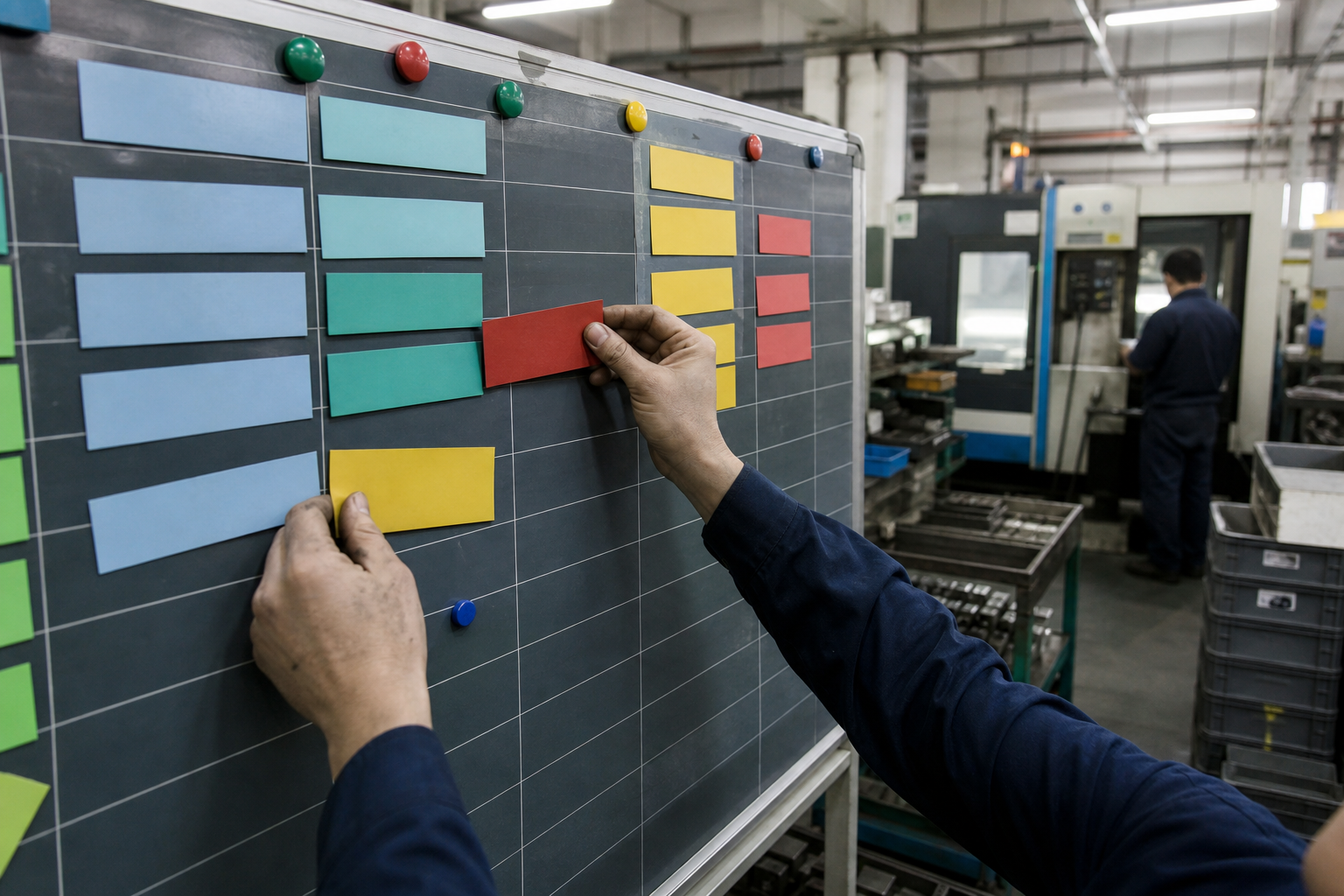
At 10 a.m., the factory owner is being pressed by a customer to approve an urgent order, requiring shipment by evening. The schedule is immediately adjusted, the shop floor switches orders, but two hours later, materials are still incomplete, and the original order in progress is interrupted.
The biggest risk of urgent orders is not prioritization, but the entire plant simultaneously changing sequences for different reasons. Sales focuses on commitments, planning on deadlines, and the shop floor on equipment, ultimately leading to increased costs.
Planners, shop floor supervisors, and changeover personnel gather around the production board to move order cards, appearing busy. However, if the three types of facts are not aligned, inserting an urgent order will only disrupt the existing rhythm.
What is truly needed is not faster plan adjustments, but first assessing whether this urgent order is worth it, what sacrifices it will entail, and condensing it into a single sequence table.
For factory owners, urgent order sequencing is not solely the planner's responsibility. Who has the authority to change commitments, who bears responsibility for delivery dates, and who decides whether to insert an order must be clearly defined on the same table.
Order commitment table
First, place the urgent order and affected orders in the same column, clearly stating the customer's promised delivery time, consequences of breach, whether the order can be split, and whether partial shipment is allowed. Without this table, the shop floor will treat 'urgency' as the same kind of urgency.
If sales can expedite an order but lacks authority to change the production sequence, planning is easily left accountable for the outcome. If the shop floor lacks authority to reject an unreasonable rush order, it tends to agree first and work out the consequences later as a form of self-protection.
More troubling is that sales prioritize customer relationships, planning focuses on ensuring commitments are not broken, and the shop floor prioritizes keeping equipment busy. All three positions are protecting their own performance metrics, yet no one takes responsibility for the disrupted original orders and changeover losses.
As a result, the shop floor easily slides into a situation where more work leads to more errors and less work leads to fewer errors: whoever raises the issue first may take the blame first; whoever shifts responsibility to the next process is more likely to leave the insertion risk there, and ultimately, no one is willing to properly close the changeover.
Bottleneck Capacity Table
Looking at the actual bottleneck process, it is not the average load of the entire line. If an urgent order passes through the same bottleneck equipment, the hours it occupies and the hours the original order is delayed must both be recorded.
This step prevents a false impression: the front end may seem flexible, but the bottleneck reveals the waiting time amplification.
Changeover Cost Table
Many factories calculate labor hours but neglect the cost of changeovers. Molds, fixtures, programs, first-off inspections, line cleaning, and replenishment all make the cost of urgent orders higher than the paper-based machining time.
The real losses often occur here: once the rush order is completed, the original order needs to re-source materials, retool, and wait for the first-off inspection.
Anyone who actively opposes inserting a rush order may be seen as uncooperative; meanwhile, whoever takes the order first and then passes the issue to the next process may appear to be solving the problem in the short term.
How to Prioritize Three Tables in Ten Minutes
The first step is to assess the consequences of the commitment and confirm which orders truly need priority. The second step is to evaluate the bottleneck capacity and determine which orders would be displaced by inserting the rush order. The third step is to add the changeover cost and then assess whether the switch is worthwhile.
If the benefits from the rush order are less than the delivery loss of the displaced orders and the changeover cost, the rush order should not be inserted directly. Either split the batch or revise the commitment.
Who Makes the Decision and Who Executes It?
Sales can propose a rush order, and planning is responsible for aligning the three tables. The shop floor provides the bottleneck and changeover facts, and the final decision is made by the plant manager or on-duty supervisor.
Not all rush orders should be inserted. Some factories have stable orders and minimal changeover, so a whiteboard mechanism is sufficient; however, if there are clear bottlenecks and cross-departmental coordination is required, inserting a rush order should not become the default solution.
Small, loosely structured factories first write urgent orders and original orders on a whiteboard. Medium-sized growing factories focus on aligning the definition of bottleneck. Large factories must prevent the system from automatically changing the plan without someone taking responsibility for the switching loss.
the factory owner can forward the sequence list to the plant manager, production manager, and team leader as a checklist.
Urgent order management is not about overturning the original plan, but ensuring that every insertion order can answer three questions: who to prioritize, where the bottleneck is, and what the cost is. A clear sequence list ensures that urgent orders do not become the starting point of overall chaos.
I am Huang Chaoxing, inventor of the TreeMES stack-light MES system. Follow me for more practical factory-management methods.
